10-year Treasury yields hit 4.4% for the first time since July 2025. But war, exploding debt and soaring inflation will drive yields much higher. Without big rate cuts and massive QE (a mistake), stocks and real estate will crash, resulting in a financial crisis worse than 2008.
— Peter Schiff (@PeterSchiff) March 20, 2026
🚨 The MOVE index hasn't surged like this since the trade war of 2025. pic.twitter.com/sT93bKjYWY
— Markets & Mayhem (@Mayhem4Markets) March 21, 2026
The S&P 500 just broke below all major moving averages.
When this happens, its average annualized return is -22.2%. pic.twitter.com/0dwh6euZ4J
— Lin (@Speculator_io) March 21, 2026
#SPX, 1d
1929 vs 2026 pic.twitter.com/bUmRAnJEOX
— Yuriy Matso (@yuriymatso) March 20, 2026
Can't stop thinking about this. Basically it says:
GREECE STYLE ECONOMIC COLLAPSE COMES TO THE UNITED STATES NEXT WEEK pic.twitter.com/chHYLFOIeI
— Data Driven Stocks (@stockdatamarket) March 21, 2026
The Russia shock in 2022 was a picnic compared with this global energy disaster
It is hard to decide which is the bigger disaster: the unfolding car crash in the global gas market or the mounting danger that entire countries will run out of oil.
The benchmark TTF contract for gas in Europe was €29 (£25) per megawatt-hour (MWh) in mid-February. Bank of America says it could reach €500 this winter if the Strait of Hormuz remains closed for 10 weeks, as it may well do.
That would blow through the record high seen after Russia’s invasion of Ukraine and amount to a full-blown economic emergency for Europe, the UK, Japan, South Korea and South Asia.
The picture is dramatically worse after Israel attacked Iran’s South Pars gas field, adding upstream gas and oil infrastructure to the menu of targets on both sides of the Gulf.
Over $1,100,000,000,000 wiped out from the US stock market today. Something big is about to happen.
byu/TonyLiberty inFluentInFinance
The “Home ATM” Mostly Closed in Q4
The Federal Reserve released the Financial Accounts of the United States – Z.1 (sometimes called the Flow of Funds report) for Q4 yesterday. We can use that data to calculated how much equity homeowners withdrew from their homes last quarter.
Mortgage Equity Withdrawal is an aggregate number and is a combination of homeowners extracting equity – hence the name “MEW” – and normal principal payments and debt cancellation (modifications, short sales, and foreclosures).
Quarterly Increase in Mortgage Debt
Here is the quarterly increase in mortgage debt from the Federal Reserve’s Financial Accounts of the United States – Z.1. In the mid ‘00s, there was a large increase in mortgage debt associated with the housing bubble.

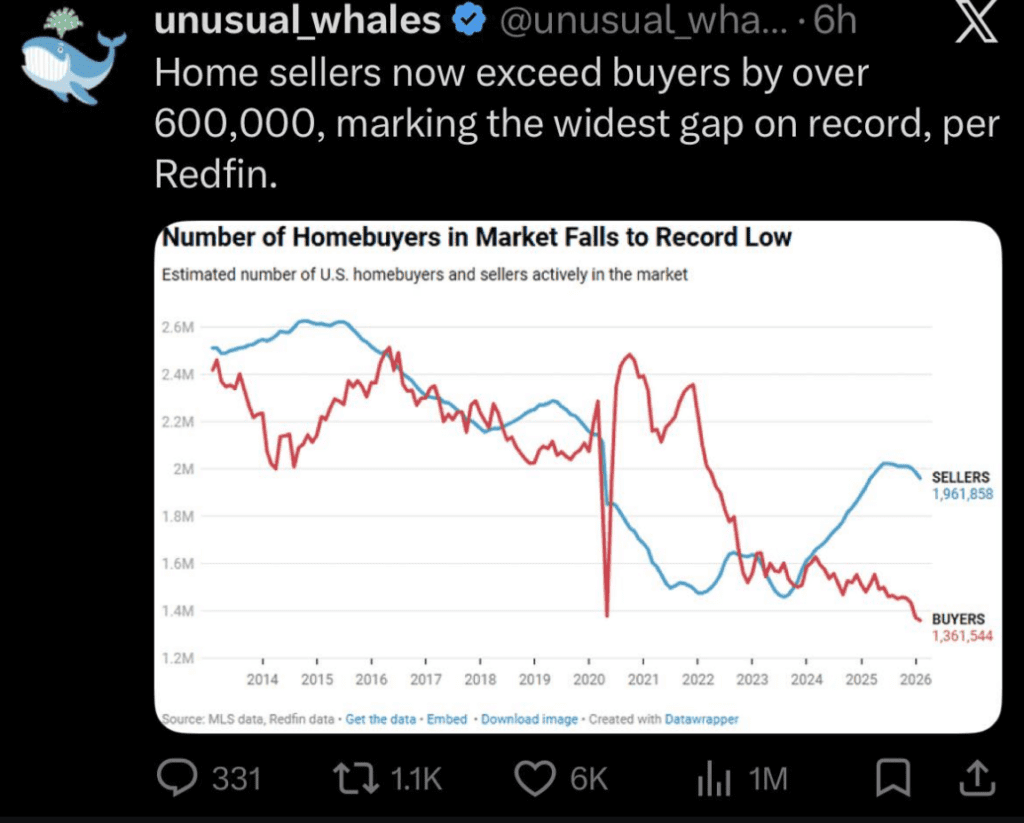
Spring is traditionally the busiest season for home sales, and while this year’s market dynamics have shifted strongly in favor of buyers, broader forces in the economy are creating significant challenges.
The most important factor in any season is mortgage rates. They were expected to be lower this year, as the Federal Reserve dropped its lending rate to counter inflation, but the war with Iran has turned that on its head. The cost of oil is shooting higher, leading to rising inflation and causing the Fed to reconsider.
Now U.S. bond yields are rising, with mortgage rates following suit.
The average rate on the popular 30-year-fixed mortgage had started this year lower, even briefly dipping below 6% at the end of February, but it rose sharply this week to 6.53% on Friday, the first day of spring, according to Mortgage News Daily. It is now just 18 basis points below where it was a year ago.