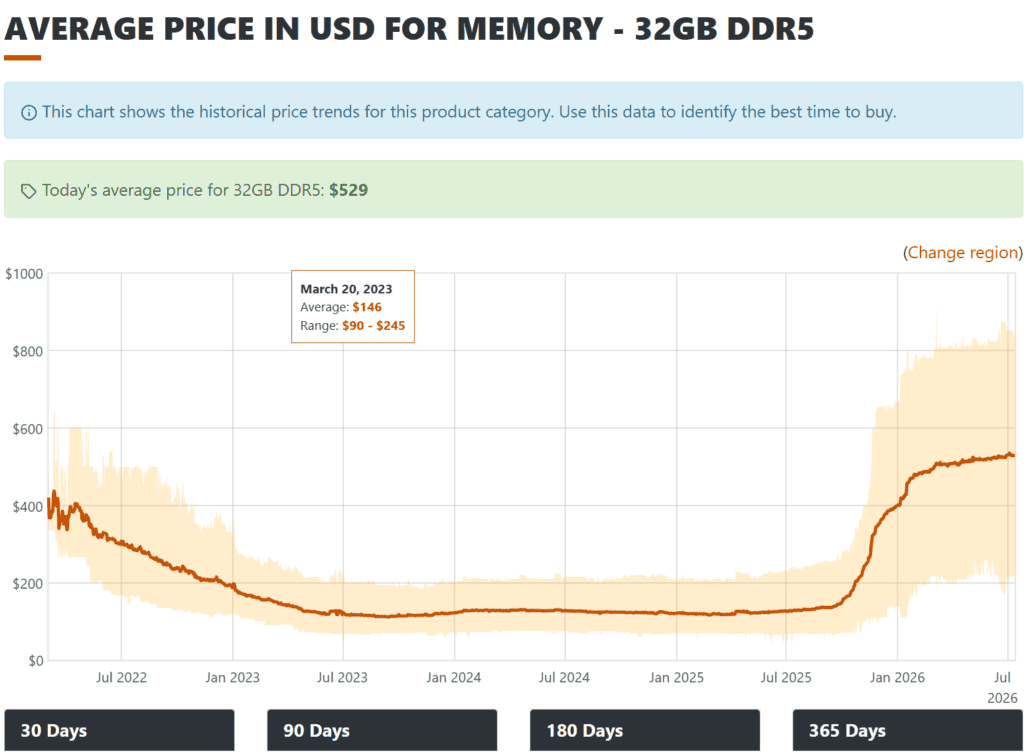
For the past two years, the trade looked almost impossible to get wrong.
AI demand exploded.
Memory prices exploded.
SK hynix.
Micron.
Samsung.
Everyone wanted more exposure because every AI server needed more DRAM and HBM.
Now I’m starting to wonder if people are watching the wrong number.
Everyone is focused on whether DDR5 prices have stopped climbing.
I think the better question is…
Why now?
Memory rarely peaks because demand suddenly disappears.
It peaks because supply slowly catches up.
Or buyers realize they’ve already ordered enough.
The headlines still sound bullish.
But the momentum underneath starts fading.
This cycle is different from every PC upgrade cycle before it.
Consumer demand isn’t driving memory anymore.
AI is.
Chipmakers shifted enormous amounts of production away from traditional DDR5 and into HBM because that’s where the money was.
That decision created shortages.
Prices exploded.
Profit margins followed.
Here’s what worries me.
AI demand can stay strong.
Memory stocks can still disappoint.
Markets don’t price today’s demand.
They price tomorrow’s growth.
DDR5 prices no longer racing higher might be the first sign expectations have gone too far.
HBM will probably stay tight.
AI spending isn’t disappearing overnight.
But once price gains start slowing, investors stop asking how high profits can go.
They start asking whether peak profitability is already here.
That’s usually how these cycles end.
Not with a crash.
With a slowdown.
First prices stop accelerating.
Then earnings surprise less.
Then analysts lower forecasts.
Only after that do investors realize the story changed months earlier.
The biggest mistake investors make is waiting for bad news.
Commodity-like businesses rarely ring a bell at the top.
The first warning is usually much quieter.
The chart stops making new highs.
Prices flatten.
Management starts using words like “normalizing.”
Everyone still agrees the long-term story is intact.
That’s exactly what makes the transition so dangerous.
I’m still bullish on AI.
I just think investors need to separate AI from AI stocks.
Those aren’t always the same trade.
The companies can keep building.
The technology can keep advancing.
Demand can keep growing.
And the stocks can still struggle if perfection was already priced in.
That’s why I don’t think this story is really about DDR5.
It’s about expectations.
The market has spent months assuming memory prices only go one way.
History says that’s usually when it’s worth asking the opposite question.