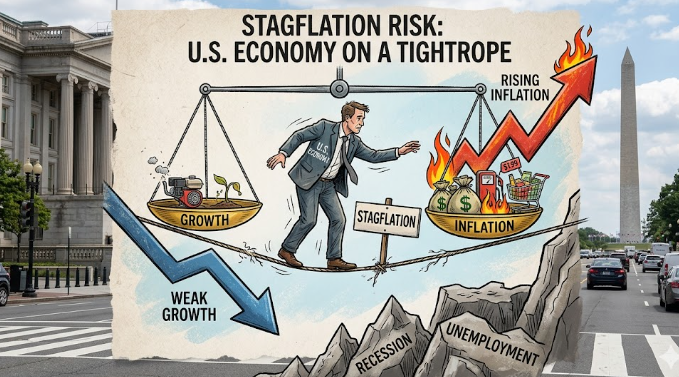
New economic data released today delivered a troubling combination for the Federal Reserve and the broader U.S. economy.
The second estimate of Q4 GDP came in at just 0.7 percent, far below the 1.4 percent economists expected and marking the second weakest growth reading in the past 3.5 years.
At the same time, inflation pressures remain stubborn.
The Core PCE Price Index rose to 3.1 percent, the highest level in about 2 years, showing that underlying price pressures are still running well above the Federal Reserve’s target.
That combination is what economists worry about most.
Growth is slowing while inflation risks remain elevated.
That is the basic formula for a stagflation type environment.
It does not mean the United States is repeating the 1970s yet. But the direction of the data is moving closer to that kind of problem.
Another signal that the economy is weakening came from retirement data.
A record 6.0 percent of workers in Vanguard managed 401k plans took hardship withdrawals in 2025. That figure was 4.6 percent in 2024 and has nearly quadrupled since 2020.
Hardship withdrawals have now increased for 6 consecutive years.
The median withdrawal was about 1900 dollars, and the most common reasons were avoiding foreclosure or eviction and paying medical bills.
That trend suggests financial stress among households is rising even before the full impact of slowing economic growth is felt.
Markets also noticed something unusual in today’s reaction.
Normally, weak GDP numbers push Treasury yields lower because investors expect the Federal Reserve to cut interest rates.
That did not happen this time.
Even with GDP collapsing to 0.7 percent growth, bond yields barely moved.
The reason is inflation risk.
Although the headline PCE inflation reading came in at 2.8 percent year over year, slightly below expectations, underlying price pressures remain sticky and the geopolitical situation is pushing new inflation risks into the system.
Energy markets are already under pressure because of the war with Iran and instability around the Strait of Hormuz.
If energy prices surge further, inflation could accelerate again even as economic growth slows.
That creates a serious policy problem for the Federal Reserve.
Cutting rates too quickly risks reigniting inflation. Keeping rates high risks pushing the economy deeper into a slowdown.
Because of this tension, markets are now expecting at most one Federal Reserve rate cut in 2026.
In other words, the Fed may have very limited room to respond if economic conditions deteriorate further.
Private demand in the economy is still growing at 1.9 percent, which shows that the situation is not yet a full stagflation scenario like the 1970s.
But the trend is moving in an uncomfortable direction.
Slower growth, persistent inflation pressure, rising household financial stress, and a growing global energy shock are all appearing at the same time.
Even if this does not become a repeat of the 1970s, the economic environment could still become very difficult for markets and households alike.
And if the geopolitical crisis in the Middle East pushes oil and shipping costs higher in the coming months, the margin for error for the Federal Reserve could shrink even further.