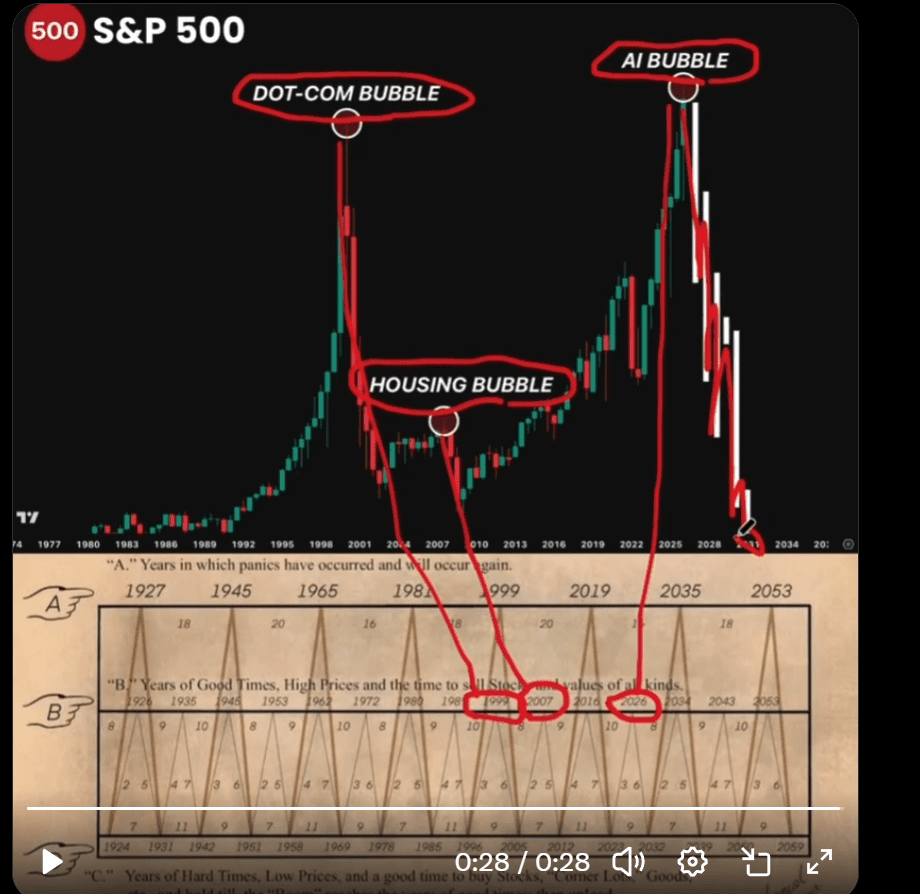
I always get skeptical when people claim they know exactly when a crash will happen.
Then I look at the list of warning signs piling up.
The 18.6 year real estate cycle theory says markets typically spend about 14 years climbing and about 4 years falling apart.
The last major housing bottom was around 2011 to 2012.
That puts the current cycle right in the window where supporters of the theory expect a peak between 2026 and 2028, with many pointing to 2027.
Normally I would dismiss cycle predictions.
But look at what is happening underneath the surface.
AI stocks now account for roughly 39 percent of the S&P 500.
The market is trading near record highs on valuation measures including P/E, forward P/E, Shiller P/E, price to book, price to sales, EV/EBITDA, Q ratio, Buffett Indicator, and return on equity.
Some analysts argue valuations now exceed levels seen in both 1929 and the 2000 dot com bubble.
Then there is the liquidity issue.
The Treasury reportedly pulled about $198 billion out of the financial system over the last month to rebuild the Treasury General Account.
That is money no longer circulating through markets.
Paul Tudor Jones has pointed out that when the S&P 500 trades around 22 times earnings, historical 10 year forward returns have often been disappointing or negative.
PTJ is the best
This is spot on.
The market is way overvalued pic.twitter.com/CBWhwekSEG
— QE Infinity (@StealthQE4) June 20, 2026
Michael Burry has warned that markets can become so detached from fundamentals that prices stop making sense.
Michael Burry Says Stocks Can Fall So Far They Break From Reality
— First Squawk (@FirstSquawk) June 21, 2026
What I find interesting is not any single warning.
It is how many warnings are showing up at the same time.
Extreme valuations.
Massive debt.
Liquidity pressure.
Heavy concentration in a handful of AI stocks.
A real estate cycle that says the danger zone is now.
Does that guarantee a crash?
No.
Markets can stay expensive longer than anyone expects.
AI could drive earnings higher.
Policymakers could inject more liquidity.
The cycle could be wrong.
But when every conversation starts sounding like “this time is different,” I start paying closer attention.
Because that is usually what people say near the top.
Liquidity tightening has started.
This could bring down the stock market. pic.twitter.com/b5wXyzsN3N
— Ted (@TedPillows) June 20, 2026
🇺🇸 US Treasury is sucking out liquidity from the economy.
$198,000,000,000 has been taken out of the markets over the past month to fill the TGA. pic.twitter.com/2zvB5N15Aa
— Ted (@TedPillows) June 20, 2026