Something about this feels familiar. Not in the details, but in the tone. The warnings are starting to sound like they did before 2008. Quiet. Technical. Polite. But the words are the same.
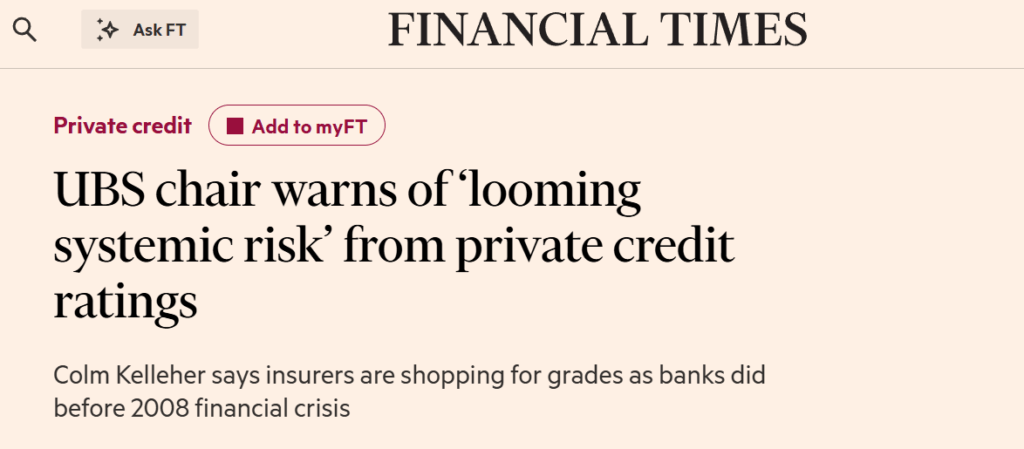
“Insurers shopping for better ratings on their private credit assets are creating a “looming systemic risk” to global finance, the chair of UBS has warned.
Speaking at the Hong Kong Monetary Authority’s Global Financial Leaders’ Investment Summit on Tuesday, Colm Kelleher said the insurance industry, especially in the US, was engaging in “ratings arbitrage” akin to what banks and other institutions did with subprime loans before the 2008 financial crisis.
Kelleher joins a growing chorus of voices pointing to risks in the multitrillion dollar insurance industry, including its holdings of illiquid private credit loans and opaque disclosures.”
That phrase, “ratings arbitrage,” is the quiet alarm. It means insurers are shopping for better grades on the same assets, trying to make them look safer than they are. The last time this kind of game spread through the system everything fell apart. Only now the danger is buried in private credit, invisible to the public and tied to the balance sheets of the companies meant to protect everyone else.
“In fact, many economists (including yours truly) had pointed out that the financial system probably would crash. But we failed to predict what would precipitate the collapse, how severe it would be and when it would happen.
This is partly a logical problem. If we knew when the crash would occur – say 30 February 2026 – then everyone would take action the day before – 29 February 2026 – which would bring the collapse-day forward, invalidating the prediction. Similarly, for the ‘how’ issue.
Consider a building which engineers think is prone to collapse. They cannot tell what the shock will be that does the damage nor when it will hit. It could be an earthquake, a fire, heavy wind gusts, a truck smashing into it …
These remarks are preliminary to the increasing references by reputable observers that various key financial markets seem shaky, including the American share market, the cryptocurrency market and the venture capital market for AI. (Currently, there is little attention being given to the Chinese financial system, but who knows?) There have been recent collapses by smaller firms, such as car-parts provider First Brands, which seem to be tied up with financing. Small collapses are integral to capitalist evolution, ‘creative destruction,’ but too many can be an indication of an impending financial crisis. There is the rule of thumb that the world has a good financial shakedown every decade or so. The last one was 17 years ago, which suggests the next might be a whopper. Please read a lot of caution into the last paragraph. It is a time for prudence rather than hysteria.
The technical problems arise because market prices reflect subjective value, what people think assets are worth, not some objective value. Contrast the value of the house you live in with its market price. If the price were to change, your dwelling would provide exactly the same comforts as it did earlier. But you may also treat your house as a financial investment, hoping that an increase in its price will add to your wealth.
That is fine, until you start borrowing, speculating that the rise in house price will add to your wealth faster. True, but if the house price falls the opposite happens and your wealth falls faster. However, the value to you of living in the house remains the same.
It is this ‘leveraged’ borrowing which is key to understanding why financial crashes are so dramatic. Typically, the source of the loan is a financial institution which has borrowed to fund the loan. Depositing amounts to the institution borrowing from you.”
Economist Brian Easton says the system has entered its final Minsky Ponzi phase, where prices only hold up because borrowed money keeps the illusion alive. No one knows the trigger, only that leverage makes every tremor louder.