Something is breaking, and it is not isolated.
It is spreading, layer by layer, system by system, market by market, and now governments are quietly telling people to change how they live.
Start with the center of it all, the energy system.
Iran just launched drone strikes on Kuwait’s largest refinery while Israel hit the South Pars gas field, the single largest natural gas field on Earth, triggering explosions across Tehran and beyond AP News report.
This is not symbolic escalation.
South Pars alone accounts for roughly 70% of Iran’s gas production, and the strike has already damaged output and halted refinery operations South Pars attack details.
At the same time, retaliation is spreading outward across the entire الخليج region, with attacks hitting infrastructure in Kuwait, Saudi Arabia, and beyond, while explosions ripple through multiple countries.
Over 1,300 Iranians are already dead.
More than 1,000 people in Lebanon are dead.
U.S. forces have taken casualties.
Over a million people have been displaced.
And the most dangerous part is not even the death toll.
It is the choke point.
Roughly 20% of the world’s oil flows through the Strait of Hormuz, and that system is now under direct threat, partially disrupted, and increasingly militarized Hormuz crisis breakdown.
Oil has already surged past $119 per barrel.
That number is not stable.
That number is a warning.
Because global officials are now openly admitting this could become the largest oil supply disruption in modern history.
“largest supply disruption in history”
IEA warning coverage
And when the International Energy Agency starts telling people to work from home, avoid flying, and even slow down their driving to conserve fuel, you are no longer dealing with a normal market event.
You are dealing with rationing signals.
Work from home, avoid air travel, reduce speed limits
Reuters report
That is demand destruction guidance, before formal demand destruction policies.
Meanwhile, they have already released 400 million barrels from emergency reserves.
The largest release ever.
And it is still not enough.
Now look at what is happening behind the scenes in the financial system.
The IMF is warning that this energy shock will push inflation higher and growth lower at the same time, the exact combination central banks cannot fix IMF warning.
They are openly discussing reduced global output and rising food prices as fertilizer and transport systems get hit.
This is how shortages cascade.
Energy first.
Then transportation.
Then food.
Then everything.
And central banks are frozen.
The European Central Bank just held rates steady, openly admitting “massive uncertainty” from the war ECB decision.
The Bank of England is now warning inflation could hit 3.5% and is preparing for more rate hikes, not cuts BoE warning.
Bond markets are already reacting violently.
UK two year yields surged to 4.4%.
Ten year yields hit 4.85%.
That is stress.
That is repricing.
That is the system adjusting to a world where energy is no longer cheap and predictable.
And here is the trap that is forming.
If central banks cut rates, inflation explodes because energy is surging.
If they raise rates, economies break under pressure.
So they do nothing.
And doing nothing, right now, is its own kind of crisis.
Because the real economy is already being squeezed.
Shipping is disrupted.
Fuel costs are surging.
Air travel is under pressure.
Governments are quietly preparing populations for reduced consumption.
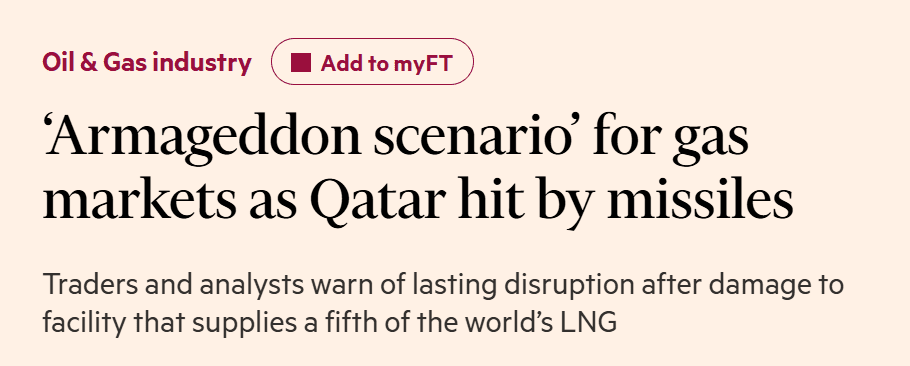
Even Qatar is warning global LNG exports could drop by 17%.
That is not a marginal change.
That is a shock to global electricity systems.
And if you zoom out just a little further, the pattern becomes impossible to ignore.
Energy infrastructure is being directly targeted.
Critical supply routes are being threatened.
Emergency reserves are being drained.
Central banks are paralyzed.
Bond markets are flashing stress signals.
And global institutions are warning about inflation, recession, and supply chain breakdowns all at once.
This is what the early stage of a systemic crisis looks like.
Not one collapse.
Multiple pressures, all building, all reinforcing each other.
Because once energy breaks, everything built on top of it starts to crack.
And right now, the energy system is not just strained.
It is under attack.
If this continues, the consequences will not stay contained to one region or one market, they will ripple outward into every economy, every supply chain, and every household on the planet.