Something is happening inside the air travel system, and it is no longer subtle.
The strain is showing up in staffing data, operational performance, and the way passengers are experiencing airports across the country.
At the center of it is the Transportation Security Administration, where absenteeism has climbed sharply above normal levels.
Reports show TSA callouts rising to around 10.2 percent nationally, with some major hubs far higher, including spikes at airports like John F. Kennedy International Airport, Atlanta, and Houston where absenteeism has reached extreme levels compared to historical norms Reuters report.
That number matters because baseline absenteeism in this system is typically closer to 2 percent.
This is not a small deviation.
It is a multiple of normal conditions.
At the same time, tens of thousands of TSA officers are working without pay due to a broader funding disruption affecting federal operations, which is feeding directly into attendance instability and morale pressure.
More than 300 TSA officers have already resigned during this period, while callout rates at certain airports have surged into extreme ranges that force operational adjustments Business Insider coverage.
Atlanta airport. This TSA debacle must be fixed ASAP.
Airports are going to start shutting down a month from now if they don’t start getting paid. https://t.co/n1iekkm4pV
— QE Infinity (@StealthQE4) March 20, 2026
The effects are visible to travelers.
Security lines are stretching longer.
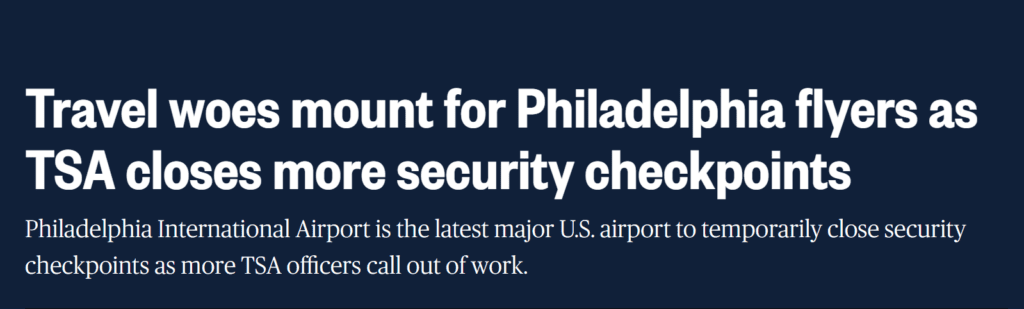
Checkpoints are being adjusted or consolidated in some locations.
Passengers are being advised to arrive several hours early to avoid missing flights.
Flight delays have exceeded 1,000 in single-day snapshots during peak disruption periods, showing how quickly bottlenecks at security checkpoints cascade outward into airline operations New York Post report.
Airline leadership is responding publicly.
Executives have criticized the situation and warned that continued staffing instability at TSA checkpoints threatens reliability across the broader air travel network, particularly during high-demand travel periods Delta CEO remarks.
The pressure is not evenly distributed.
Large hubs such as John F. Kennedy International Airport, Hartsfield Jackson Atlanta International Airport, and George Bush Intercontinental Airport in Houston handle massive passenger volumes daily. When absenteeism spikes at those locations, the impact multiplies across the system.
This is how a localized staffing issue becomes a national operational constraint.
Reduced staffing at checkpoints lowers throughput.
Lower throughput increases wait times.
Longer wait times create missed flights and cascading delays.
Those delays feed back into airline scheduling, tightening capacity and amplifying congestion.
The system is tightly interconnected, and there is limited room to absorb sustained drops in staffing performance without visible consequences.
What is emerging is not a single point of failure, but a convergence of pressures.
Labor instability.
Funding uncertainty.
Rising absenteeism.
Staff attrition.
Operational bottlenecks.
And public warnings from both regulators and industry leaders.
Each element reinforces the others.
Taken together, the pattern points to a system that is being pushed closer to its operational limits than normal conditions allow.
If these conditions persist, the effects will continue to spread beyond security checkpoints into broader flight reliability, business travel, and the movement of people and goods that depends on consistent airport throughput.
Right now, the warning signs are no longer theoretical.
They are showing up in real time, in long lines, delayed flights, and a workforce that is struggling to maintain full capacity under mounting pressure.
-DR