The real story here is not “recession fears.”
The real story is that institutions, markets, and even consumers are starting to quietly admit something much darker:
The modern economy increasingly survives through financial insulation, debt tolerance, asset inflation, and delayed recognition of losses rather than broad based prosperity.
That is the connective tissue running through all your sources.
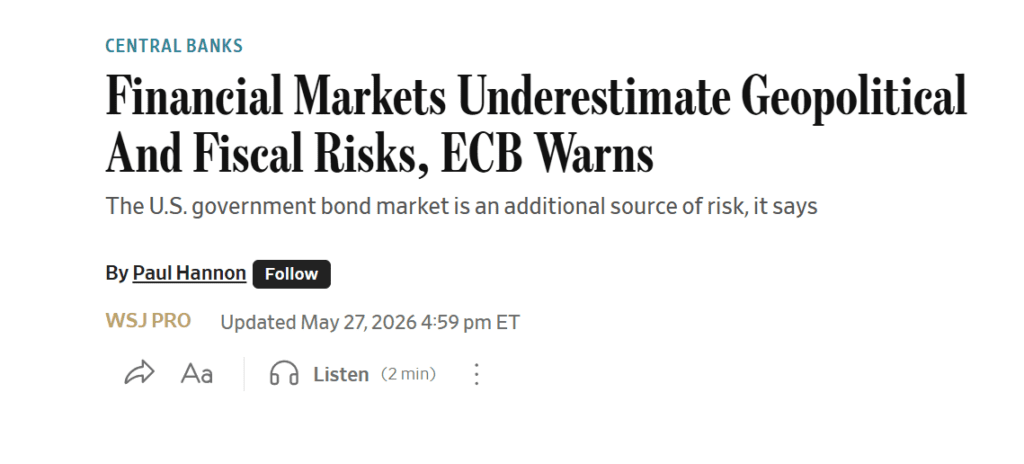
The ECB warning matters because central banks almost never talk this way unless they believe markets have become psychologically detached from actual risk. The language coming out of Europe right now is unusually direct. Officials are openly warning that investors may be underpricing geopolitical escalation, sovereign debt stress, energy disruptions, and fiscal instability while asset prices remain historically elevated.
That alone is important.
But the deeper signal emerges when you combine it with the consumer side.
NerdWallet’s new Financial Resilience Index basically exposes the hidden contradiction underneath the “strong consumer” narrative. Americans report feeling financially stable on the surface, yet 37% say they will rely on credit just to manage expenses this month, while 66% expect a recession within a year.
That is not confidence.
That is adaptation.
Those are completely different things.
People often confuse continued spending with economic strength.
But spending powered by debt rollover, credit dependency, shrinking savings buffers, and asset appreciation can maintain the appearance of stability long after underlying conditions deteriorate.
This is why your Reddit sources actually matter here, despite the emotional exaggeration in parts of them.
The posts are not valuable because every claim is accurate.
They are valuable because they reveal psychological conditions that formal economic statistics struggle to capture.
The recurring theme across those threads is not simply “collapse.”
It is perceived exclusion from recovery.
One of the strongest buried patterns here is the widening divergence between:
• asset holders
• institutional capital
• financially insulated households
and
• everyone operating paycheck to paycheck
That “capital hiding in everything bubble” framing is crude, but it points toward a real structural phenomenon:
In an environment where inflation, geopolitical instability, debt monetization fears, housing shortages, and currency dilution concerns all persist simultaneously, capital floods into:
• stocks
• housing
• AI infrastructure
• commodities
• private credit
• land
• anything perceived as inflation resistant
That creates the appearance of prosperity because asset prices stay elevated.
But it simultaneously increases exclusion for anyone without meaningful asset ownership.
That is one of the most important economic tensions of this decade.
The ECB warnings reinforce this directly.
Officials are essentially saying markets may be treating systemic risks like temporary inconveniences instead of structural pressures.
And notice the timing.
The warning arrives while:
• Middle East instability threatens energy markets
• sovereign debt burdens keep rising
• AI capital concentration accelerates
• private credit stress is emerging
• insurance markets are destabilizing in climate exposed regions
• household resilience increasingly depends on access to debt
Those are not isolated stories anymore.
They are converging pressures.
Another major buried signal is the climate mortgage angle.
That topic sounds fringe until you follow the incentive chain.
If insurance becomes unaffordable or unavailable in vulnerable regions, mortgage risk changes dramatically because modern housing finance depends on insurability assumptions. Once insurers retreat, banks eventually reassess collateral risk, municipalities lose tax stability, and property liquidity weakens. That cascading logic increasingly appears in both academic and financial system discussions.
That does not mean imminent nationwide collapse.
But it does mean parts of the financial system may already contain delayed recognition problems similar to previous credit cycles.
The strongest line in all these sources may actually be implicit rather than explicit:
The economy can look statistically functional while large sections of the population experience conditions that psychologically resemble collapse.
That distinction matters enormously.
GDP growth does not automatically produce perceived stability.
High stock prices do not automatically produce social confidence.
Low unemployment does not automatically produce economic security.
A society can remain financially operational while becoming emotionally and structurally brittle underneath.
That is exactly what many of these sources are circling around from different angles.
Even the Reddit doom posting accidentally reveals something real:
People increasingly interpret ordinary economic pressure as evidence of systemic abandonment.
That shift in perception alone becomes economically important because consumer psychology affects:
• spending
• borrowing
• investing
• political behavior
• migration
• fertility
• trust in institutions
And once enough people stop believing the future will improve materially, economic behavior itself starts changing.
That is why this moment feels strange.
Markets still behave as if liquidity and central bank stabilization mechanisms can indefinitely suppress systemic risk.
But institutions themselves are beginning to publicly warn that investors may be deeply underestimating how many fragilities are stacking simultaneously.
The contradiction is becoming harder to ignore:
Asset inflation keeps signaling optimism while institutional warnings, debt dependency, geopolitical instability, and household anxiety increasingly signal underlying stress.
That tension may be the actual defining economic story of this era.
The most demoralizing chart you will see today pic.twitter.com/pJIBiuXtCx
— Leyla (@LeylaKuni) May 26, 2026
Interesting price action today.
Oil is down.
Silver is down.
Copper is weak.
Gold is also down.This is not isolated weakness in one commodity, the entire commodity board is cooling together.
One session doesn’t confirm a macro shift, but if this weakness sustains, it starts… pic.twitter.com/YYIgp0cT0Y
— Macro Liquidity by Sunil Reddy (@Macrobysunil) May 27, 2026
So a little history lesson for you all, the 1929 crash was not the start of the Great Depression, but it was a major cause of it. Herbert Hoover was essentially the Trump of a century ago, a businessman obsessed with the market and not exactly the sharpest tool in the shed. When…
— Michael Bento (@MichaelPBento) May 27, 2026
In case you haven't noticed, there is just a tad excess liquidity out there pic.twitter.com/SP2C4NKNjY
— zerohedge (@zerohedge) May 27, 2026