A new debate is spreading across Wall Street.
Is the market starting to resemble the period right before the Global Financial Crisis?
Bank of America strategist Michael Hartnett believes the comparison is becoming harder to ignore.
In a recent note, Hartnett warned that asset performance in 2026 is beginning to look “ominously close” to the price action seen between mid 2007 and mid 2008. That period, of course, was the final phase before the financial system unraveled during the Global Financial Crisis.
According to Hartnett, markets are now “ominously trading a 07 to 08 analog.”
But not everyone agrees.
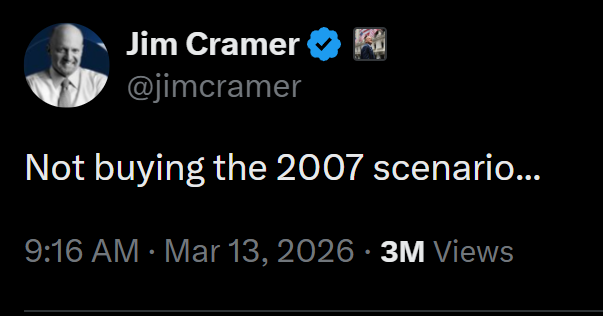
Television personality Jim Cramer is pushing back on the comparison.
Cramer said he is “not buying the 2007 scenario,” rejecting the idea that current market conditions resemble the period leading into the 2008 collapse.
The disagreement highlights how uncertain the current macro environment has become.
Several risks are now building at the same time.
One of the biggest concerns on Wall Street is private credit.
Private credit has exploded over the past decade into a multi trillion dollar asset class as banks pulled back from traditional lending. But that market is now facing new stress.
Funds are seeing redemptions from investors, underwriting standards are facing growing scrutiny, and analysts are beginning to question how some borrowers will survive in a world where artificial intelligence could disrupt entire industries.
If private credit begins to crack, the ripple effects could spread quickly.
Banks have exposure.
Institutional investors have exposure.
And many of the companies that dominate today’s technology narrative rely on easy financing conditions.
Which brings the next concern into focus.
Artificial intelligence.
A large portion of the NASDAQ Composite rally over the past two years has been driven by AI enthusiasm. If funding conditions tighten and the private credit market weakens, the companies relying on that capital could face serious pressure.
And if the NASDAQ weakens significantly, the broader market could follow.
At the same time, a completely different macro threat is building in the background.
Energy.
The war with Iran has already pushed oil prices sharply higher, raising fears that the world could face another period of stagflation, where inflation rises at the same time economic growth slows.
That combination creates a nightmare scenario for central banks.
Higher inflation forces policymakers to keep interest rates elevated, even while economic growth deteriorates.
Markets are starting to notice the risk.
Prediction markets tracked by Kalshi now show the probability of a U.S. recession this year rising to 36 percent, an increase of nearly 15 points in just a few weeks.
None of this guarantees that the current cycle will turn into another 2008 style collapse.
But the fact that serious analysts are even making the comparison shows how fragile the situation has become.
Because when multiple risks begin to align at the same time, financial systems can move from stability to crisis much faster than most investors expect.