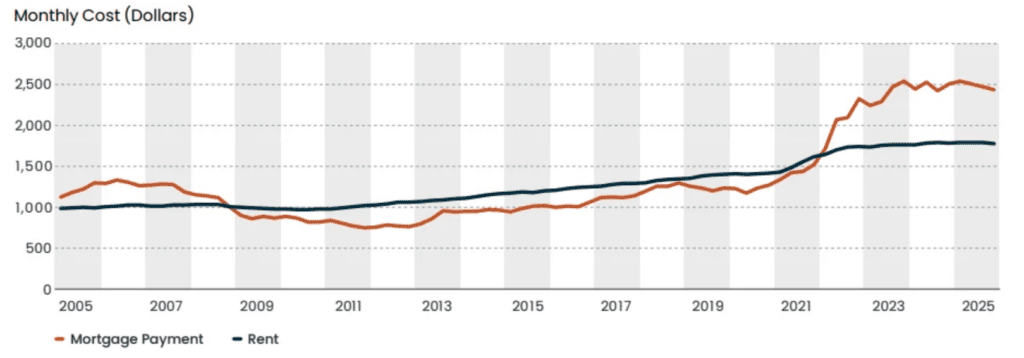
At first glance, it looks contradictory. Rent growth slows, but rent still feels unaffordable.
The reason is simple. Growth and level are not the same thing.
Recent data shows that rents have softened in many markets. In 2025, asking rents declined year over year in 74 out of 150 крупных metro areas tracked by RealPage. Vacancy rates also rose to around 5.2%, above pre-pandemic levels, as new supply started to outpace demand.
On paper, this looks like relief.
But it does not change the level people are already paying.
The core issue is cumulative. Over the past years, rents reset to a much higher baseline. Once that happens, “flat” no longer means affordable. It just means prices are no longer rising as fast.
At the same time, affordability has been deteriorating structurally. In 2024, about 22.7 million renter households were cost-burdened, meaning they spent more than 30% of income on housing. That is roughly 49% of all renters, and about 2.3 million more than in 2019.
This is not just about recent rent increases. It reflects a longer shift in the market.
One of the key changes is at the low end. The supply of lower-cost units has been shrinking relative to demand. Even if rent growth slows, households are competing in a market where affordable options are harder to find.
There is also pressure from the ownership side.
Since 2022, higher home prices and mortgage rates have pushed ownership further out of reach. By late 2025, affording a median-priced home required over $120,000 in income. That keeps more households in the rental market, extending demand even when new supply is coming online.
This effect is broad. Affordability pressure is no longer limited to low-income renters. Among households earning $75,000 or more, about 14% were still cost-burdened in 2024, a noticeable increase compared to 2019.
So the situation is not driven by a single factor.
It is the result of three things interacting:
- a higher rent baseline built over time
- reduced availability of lower-cost housing
- and a tighter path into homeownership
Slower rent growth does not resolve affordability when the level is already high and demand remains elevated. The next phase depends on what changes first: overall supply, low-cost supply, or access to ownership.
Sources:
h/t Ok_Astronomer_7797