by Dismal-Jellyfish
https://www.snb.ch/n/mmr/reference/stabrep_2023/source/stabrep_2023.n.pdf

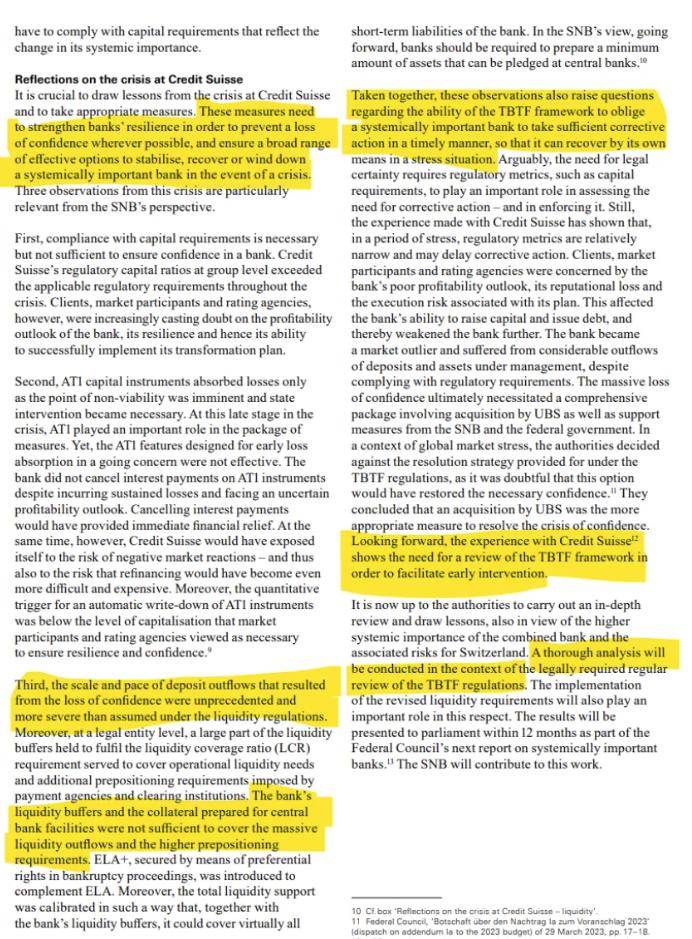
- These measures need to strengthen banks’ resilience in order to prevent a loss of confidence wherever possible, and ensure a broad range of effective options to stabilise, recover or wind down a systemically important bank in the event of a crisis.
- Third, the scale and pace of deposit outflows that resulted from the loss of confidence were unprecedented and more severe than assumed under the liquidity regulations.
- The bank’s liquidity buffers and the collateral prepared for central bank facilities were not sufficient to cover the massive liquidity outflows and the higher prepositioning requirements.
- Taken together, these observations also raise questions regarding the ability of the TBTF framework to oblige a systemically important bank to take sufficient corrective action in a timely manner, so that it can recover by its own means in a stress situation.
- Looking forward, the experience with Credit Suisse shows the need for a review of the TBTF framework in order to facilitate early intervention.
- A thorough analysis will be conducted in the context of the legally required regular review of the TBTF regulations.
They aren’t touching forward guidance on the new entity..
TLDRS:
- Swiss National Bank calls for new measures after Credit Suisse calling into question Too Big to Fail
- “these observations also raise questions regarding the ability of the Too Big To Fail framework to oblige a systemically important bank to take sufficient corrective action in a timely manner”
- The scale and pace of deposit outflows that resulted from the loss of confidence were unprecedented and more severe than assumed under the liquidity regulations.
- The bank’s liquidity buffers and the collateral prepared for central bank facilities were not sufficient to cover the massive liquidity outflows and the higher prepositioning requirements.