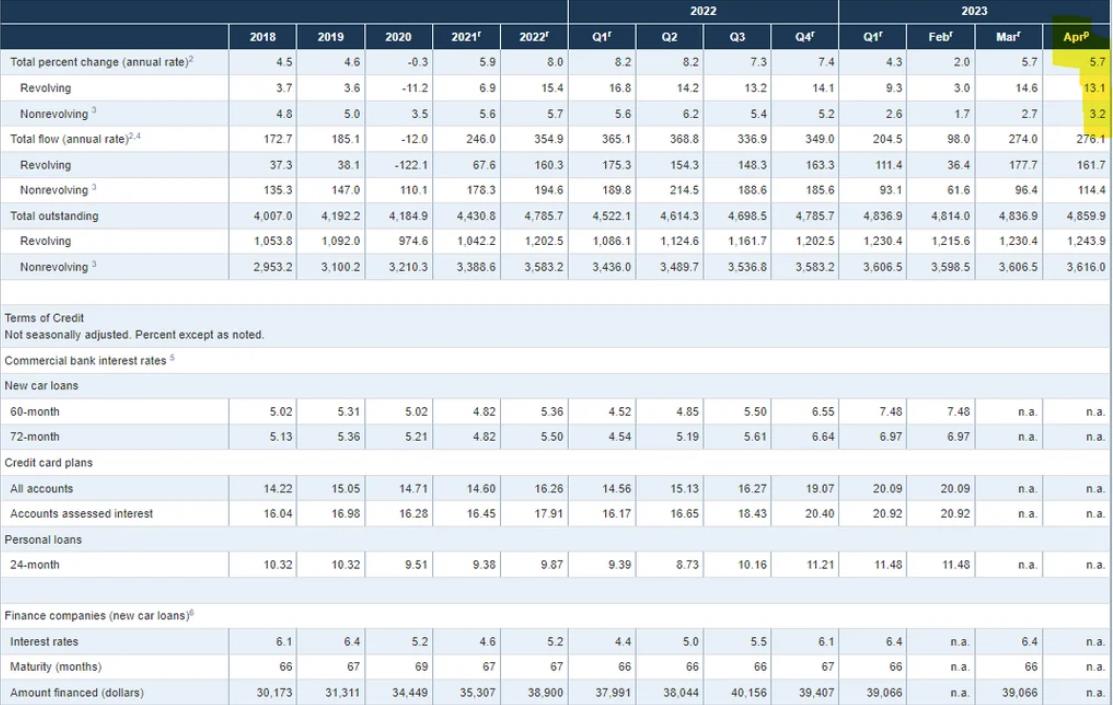
In April, consumer credit (AKA consumer DEBT) increased at a seasonally adjusted annual rate of 5.7%. Revolving credit (credit cards) increased at an annual rate of 13.1% , while nonrevolving credit (student loans, personal loans, mortgages) increased at an annual rate of 3.2%.

by Dismal-Jellyfish

Source: https://www.federalreserve.gov/releases/g19/current/g19.pdf
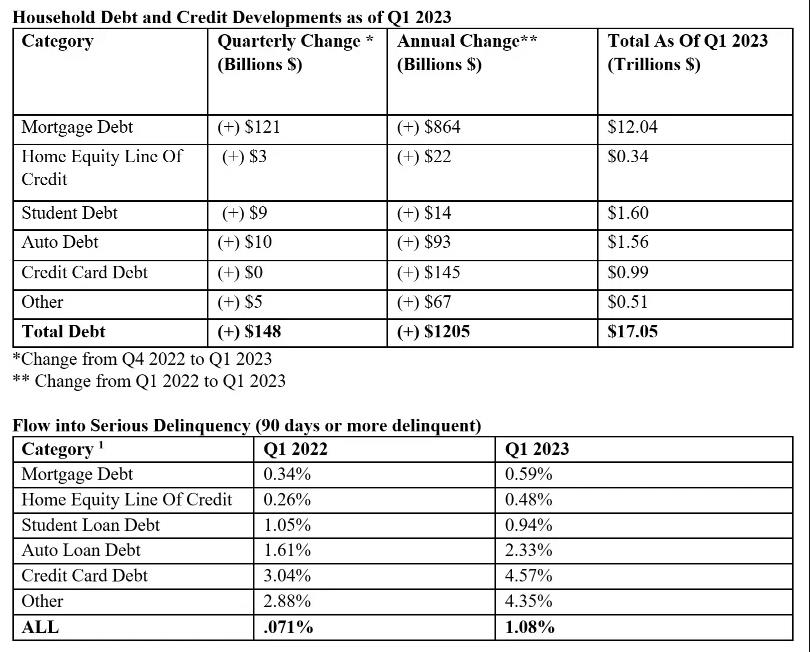
Remember, From 1st quarter 2022 to 1st quarter 2023, total household debt has increased $1,205 billion to $17.05 trillion (+7.57%)–Mortgage balances ($864 billion), HELOC ($22 billion), Student loans ($14 billion), Auto loans ($93 billion), Credit Card debt ($145 billion), Other ($67 billion):

  • Total household debt has risen by $148 billion, or 0.9 percent, to $17.05 trillion in the first quarter of 2023.
  • Mortgage balances climbed by $121 billion and stood at $12.04 trillion at the end of March.
  • Auto loans to $1.56 trillion.
  • Student loans to $1.60 trillion.
  • Credit Card debt $986 billion.

However, unlike the banks above, there are no fancy programs designed to keep households afloat in this inflating economy–and boy are households starting to feel it, especially in the areas like services and housing (that are BIG components of CPI–and way more ‘sticky’ than goods).


Uh-oh! It looks like you're using an ad blocker.

Our website relies on ads and the generous support of readers like you to keep delivering free, high-quality content. Right now, we are facing serious funding challenges and we need your help more than ever. Disable your ad blocker and this message will vanish. You can also sign up for a membership to enjoy an ad-free experience while supporting our work: https://citizenwatchreport.com/plans/subscriptions/ Your support helps us stay independent, continue our work, and keep content free for everyone. We truly appreciate your understanding and thank you for standing with us.