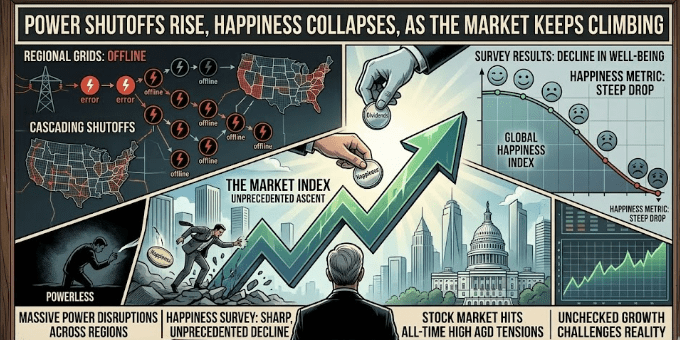
Four headlines appeared today that, when placed together, raise a question that economists and politicians rarely want to confront.
More Americans are having their electricity shut off as unpaid bills pile up.
Analysts are asking what the S&P 500 may be hiding about the real condition of the economy.
Some economists are openly wondering whether the United States may already be in a recession.
And surveys show that happiness in America has fallen to record lows.
When you look closely at what is actually happening, those four stories begin to fit together.
Electricity shutoffs are rising across the country because millions of households simply cannot keep up with their utility bills anymore.
Energy prices have been climbing for years, and many families are now falling dangerously behind.
The average overdue power bill has climbed to roughly $789, which is about 32% higher than it was just a few years ago.
Meanwhile about 16% of U.S. households are now behind on their electricity payments.
That means tens of millions of Americans are living with the constant threat that their power could be shut off.
Electricity is not a luxury.
Families usually stop spending on almost everything else before they stop paying the power company.
So when utilities begin cutting off large numbers of customers, it is usually a sign that financial stress has already become severe.
And yet the stock market continues behaving as if the economy is in great shape.
The S&P 500 remains elevated and investors continue pouring money into equities.
But some analysts are beginning to ask whether those market numbers are masking deeper economic weakness underneath.
Because outside of a handful of booming sectors, parts of the economy are already slowing down.
In fact, some economists believe the downturn may already be underway even if the official statistics have not caught up yet.
Economic downturns often begin quietly.
Households start falling behind on bills.
Debt balances grow.
Consumers become cautious.
And the data confirming a recession only appears months later.
Perhaps that is one reason why happiness in the United States has dropped to the lowest levels ever recorded.
People experience the economy in their daily lives long before economists label what is happening.
They see grocery prices rising.
They see rent climbing.
They see power bills becoming harder to pay.
So when you place those four headlines side by side, the picture becomes much clearer.
Lights are being shut off.
Economists are debating recession.
Happiness is collapsing.
And yet the stock market still insists everything is fine.
If the economy is truly strong, why do so many Americans feel like they are barely holding things together?