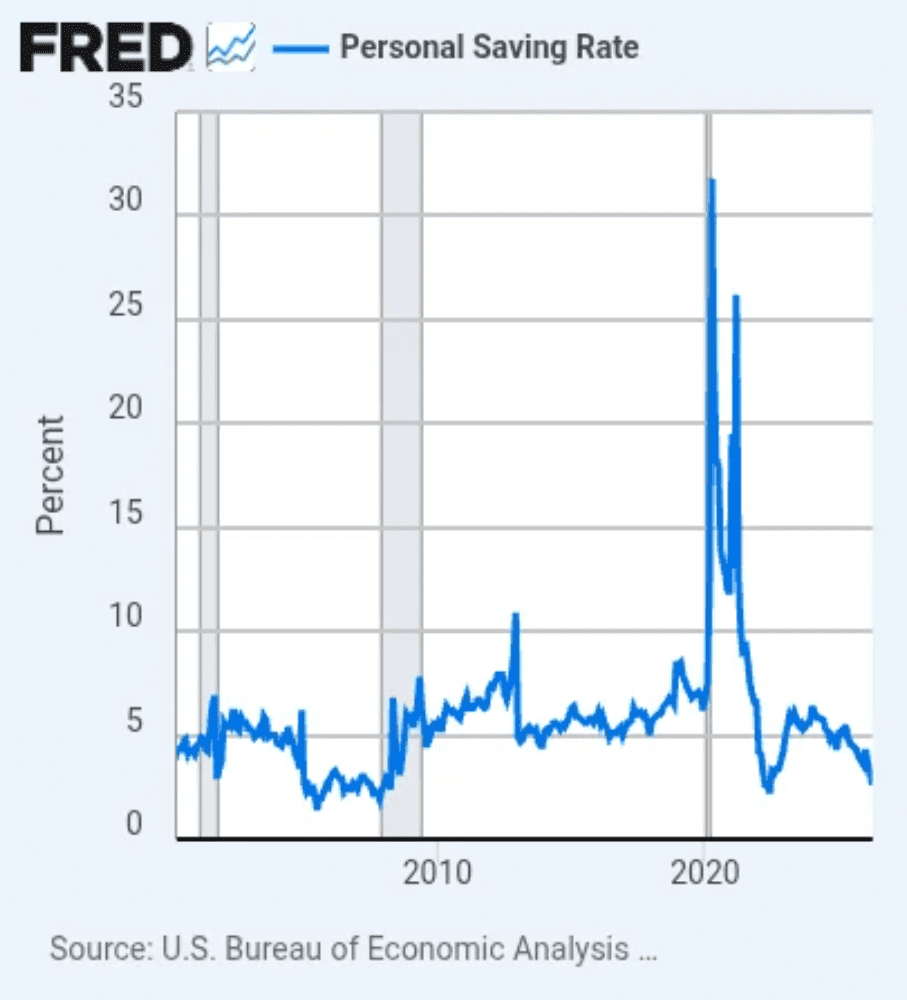
From the latest PCE report
The stock market keeps making headlines but a growing share of Americans are living paycheck to paycheck, carrying more debt, and watching housing drift further out of reach.
40% of Americans cannot plan beyond their next paycheck and 46% do not even have $500 saved for emergencies. Those are not numbers from a healthy middle class.
The split is getting harder to ignore. Asset owners are celebrating record highs while workers are getting squeezed by housing costs, debt, and a weakening market for higher income jobs.
You can only tell people the economy is booming for so long before their bank account starts arguing back.
The pressure is no longer showing up in one statistic. It is showing up everywhere at once.
— Porter Stansberry (@porterstansb) May 29, 2026
Until terms are confirmed, volatility remains. Our daily-updated indexes already reflect the latest pricing across 35M+ data points.
Geopolitical headlines are exactly why high-frequency inflation data matters. pic.twitter.com/lx3SvHYB9A— Truflation (@truflation) May 29, 2026
Americans Aren’t Imagining This Economic Burnout
“Burnout is a very real thing.
Most of us have felt it at one time or another. Maybe it’s the physical exhaustion that comes after too much exercise in too short a time. Or, in my case, one ambitious weekend of yardwork that somehow turns into three days of walking like I just finished a marathon.
Then there’s emotional burnout. Too many draining situations. Too many unresolved worries. Too many days in a row where you tell yourself, “I’ll catch my breath next week.”
But here’s the thing about burnout: It doesn’t always come from one dramatic event.
Sometimes it builds quietly…
A little stress this month. A little more next month. A bill that used to be manageable gets harder to pay. A grocery trip that used to feel routine starts to feel like a negotiation. A family dinner gets simplified. A prescription gets delayed. A repair waits.
Then one day you realize you aren’t just tired.
You’re worn down.
That, I think, is a useful way to understand the mood of the American family right now.
According to Reuters, U.S. consumer sentiment fell to a record low in May as cost-of-living concerns continued to weigh on households. The University of Michigan’s final May reading came in at 44.8, down from 49.8 in April.
That number is an abstraction, but the feelings behind it are real.
Americans aren’t gloomy because they forgot how to be optimistic. They’re exhausted because the cumulative effect of rising prices has changed the way daily life feels.
Inflation doesn’t have to be new to keep hurting
One of the most frustrating things about inflation is that even when the rate of inflation slows, prices usually don’t go back to where they were.
That’s where a lot of the public discussion goes sideways.
A politician or pundit can say, “Inflation is down,” and technically that may be true because the annual rate of price increases has decreased. But the family buying eggs, gas, school clothes and medication hears something very different.
They hear: “Things should feel better now.”
But they don’t feel better.
That’s because inflation measures the rate at which prices are rising. If inflation falls from 8% to 3%, prices are still rising – just more slowly. The old purchasing power generally does not come back.
That’s why the cumulative effect matters so much.
Using CPI-based inflation calculators, $100 in 2001 had roughly the same buying power as more than $180 by 2025 – and higher still by 2026, depending on the month measured.
That is not a one-month inconvenience. That is a long, slow erosion.
And it helps explain why so many Americans feel cynical when they hear that the economy is “strong.” Strong for whom? Strong compared to what? Strong enough to make the grocery bill feel normal again?”
Americans Are Falling Behind on Their $1.25 Trillion Credit-Card Bill
A key inflation gauge accelerated in April to the highest level in three years, the latest sign that spiking gas prices and higher food costs are squeezing Americans’ finances.
Inflation jumped to 3.8% in April compared with a year ago, the Commerce Department said Thursday, up from 3.5% in March and the highest since May 2023. On a monthly basis, prices rose 0.4%, down from the 0.7% jump in March.
Exxon warns oil inventories will hit dangerously low levels in weeks, forcing prices to shoot higher