Spain crushes Messi farewell as bloated halftime circus wrecks rhythm.
Something strange happened during the biggest football match on earth.
The final was decided on the pitch, but the biggest argument afterward happened away from the goals.
FIFA had spent years pushing football into a bigger global entertainment machine.
The World Cup final was where that experiment became impossible to ignore.
Spain beat Argentina 1-0 in extra time, with Ferran Torres scoring in the 106th minute after Argentina went down to 10 men.
Spain lifted the trophy.
But the conversation immediately moved toward what happened during the break.
For the first time in World Cup final history, FIFA introduced a halftime entertainment show.
The lineup looked more like a Super Bowl production than a traditional football final, featuring global stars including Shakira, Madonna, Justin Bieber, BTS, Burna Boy, Coldplay, and the Muppets.
Then came the problem.
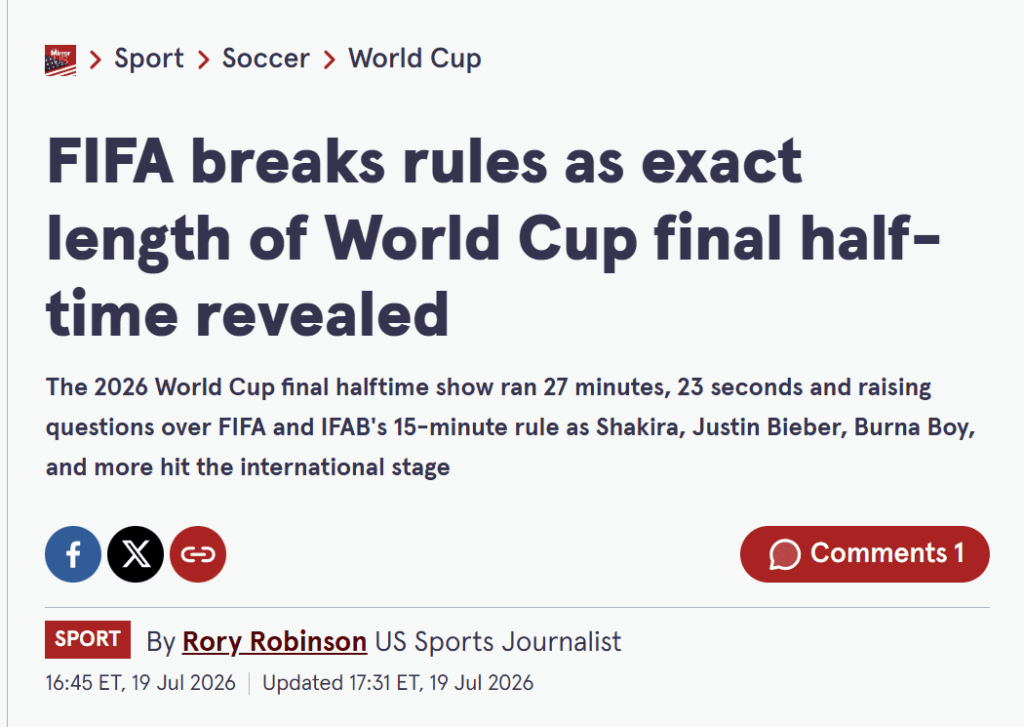
The halftime show lasted 27 minutes and 23 seconds.
The normal IFAB rule allows a maximum 15-minute halftime break.
FIFA had reportedly asked for an exception, while teams were told the total interruption would stay closer to 20 minutes.
Instead, the final break stretched almost twice as long as football’s traditional rhythm.
That detail mattered because football is built around timing.
Players spend their entire careers following the same routine.
Recover.
Receive tactical adjustments.
Warm up.
Return.
A World Cup final is the one moment where every detail matters.
Then the sport inserted a television production window in the middle of it.
The backlash was immediate.
Some critics called it an “anti-football” decision because the break changed the normal flow players have trained around their entire careers.
Wayne Rooney criticized the performance during BBC coverage, calling it “crap,” while many supporters questioned why FIFA chose a massive entertainment production during the most important match on the calendar.
The strange part is FIFA’s decision makes perfect sense from a business perspective.
The World Cup is no longer only a sporting event.
It is a global media product.
Every celebrity appearance creates attention.
Every additional minute creates more commercial value.
Every new entertainment layer gives broadcasters and sponsors another reason to pay.
But football has always sold something different.
Unpredictability.
Tradition.
The feeling that the match itself is the spectacle.
Then another financial clue appeared.
The final took place at MetLife Stadium in the United States.
Spain received $50 million for winning FIFA’s tournament prize, while the total prize pool reached $655 million.
But players competing in U.S. matches can face federal taxes and state-level “jock taxes” depending on circumstances.
Federations and players do not necessarily receive the same tax treatment.
The final became a perfect example of modern sports economics.
The host country gets the event.
The broadcasters get the audience.
The sponsors get the exposure.
Governments get tax revenue.
Everyone has a financial reason to expand the spectacle.
Except perhaps the players trying to play a 120-minute football match.
And on the field, Spain showed another major story developing.
Argentina’s collapse was dramatic.
The defending champions failed to register a shot on target until the 117th minute.
Spain’s younger generation, pressing system, and deeper squad defeated a team still carrying the weight of the Messi era.
At 39 years old, Lionel Messi likely played his final World Cup match without the fairy-tale ending many expected.
Spain now hold both the men’s and women’s World Cups, with Rodri winning the Golden Ball.
The country that won its first men’s World Cup in 2010 has built another championship generation.
That may be the football story historians remember.
But the controversy surrounding the final revealed something bigger.
FIFA is trying to turn football’s biggest moments into global entertainment events.
The question now is whether the sport can keep its identity while becoming an even bigger business.
Because the World Cup final proved one thing.
The game itself may still be the greatest show on earth.
But FIFA is increasingly trying to sell everything around it too.
The Athletic – https://www.nytimes.com/athletic/live-blogs/spain-vs-argentina-live-updates-world-cup-2026-final-score-result/o7c5wGK8uury/
MarketWatch – https://www.marketwatch.com/story/the-world-cupwinning-side-will-make-50-million-and-the-irs-gets-a-cut-10f0780b
AP News – https://apnews.com/article/argentina-spain-world-cup-final-score-messi-fccc26aa12d9226e63d06b601b770617
The Mirror – https://www.themirror.com/sport/soccer/world-cup-final-halftime-length-1945559
Mediaite – https://www.mediaite.com/media/news/i-thought-it-was-crap-soccer-legend-trashes-world-cup-halftime-show-in-wild-moment-on-bbc-broadcast/
Yahoo Sports – https://sports.yahoo.com/articles/anti-football-abomination-fifa-slammed-214539443.html (extra criticism)
Time – https://time.com/article/2026/07/19/world-cup-halftime-show-review/ (show review)