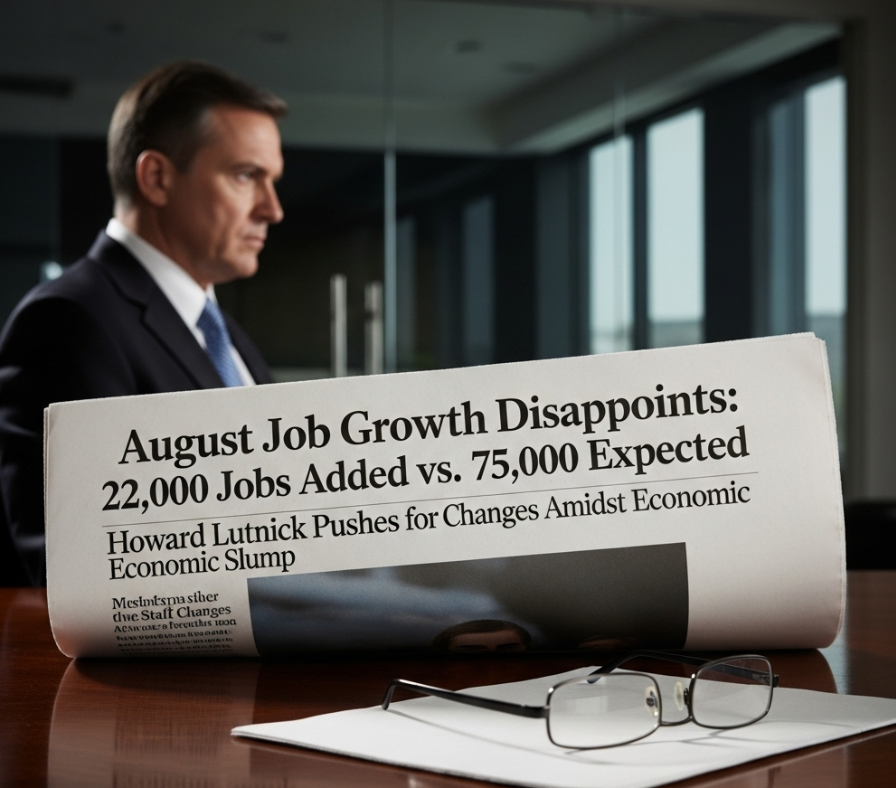
August delivered a jolt the labor market could not absorb. Employers added 22,000 jobs, far below the 75,000 forecast, exposing a system that is faltering under pressure. Unemployment climbed to 4.3 percent while wage growth inched 0.3 percent month-over-month and 3.7 percent year-over-year, missing projections. Each number reflects more than performance. It reveals cracks threatening economic stability, shaking confidence among workers, investors, and policymakers.
Howard Lutnick admitted, “Economic data will not get better until we make staff changes” https://www.cnbc.com/2025/09/05/trump-bls-jobs-lutnick.html
. The Bureau of Labor Statistics is being reshaped to serve political optics. Compliance has replaced accuracy. Missed forecasts justify purges while underlying labor problems remain unaddressed. The agency is no longer measuring the market. It is steering the narrative.
Employers respond to the distortion. Layoffs surged to the highest level since the first quarter of 2023 while fewer construction workers quit, clinging to jobs amid wobbling projects https://www.abc.org/News-Media/News-Releases/abc-construction-quit-rate-plummets-to-9-year-low
. Stability arises from necessity not opportunity. Innovation stalls, wage pressure softens, and employees become trapped in precarious roles.
Ho Lee fuk pic.twitter.com/EY8JJAmKMb
— The Great Martis (@great_martis) September 5, 2025
*LUTNICK: ECONOMIC DATA WON’T GET BETTER UNTIL WE MAKE STAFF CHANGES
They’re saying it out loud now.
— Spencer Hakimian (@SpencerHakimian) September 5, 2025
Rising unemployment and stagnant wages reshape consumer behavior. Families tighten spending, reducing demand for goods and services, which in turn slows business growth and reinforces the labor market contraction. The decline feeds a feedback loop where caution suppresses activity and policies prioritize appearance over results.
Administration interventions accelerate the pattern. Rewriting BLS processes ensures data aligns with expectations instead of reality. Every report signals compliance while concealing fragility. Forecasts transform into tools of control. Decimal gaps become levers to enforce obedience.
The labor market does not collapse on its own. It is being steered, constrained, and reframed. Workers, households, and investors face shrinking opportunities while institutional design shapes what is seen and what is hidden. Each missed forecast amplifies uncertainty, each manipulated metric compounds the risk, and every decimal decision compounds real-world consequences.