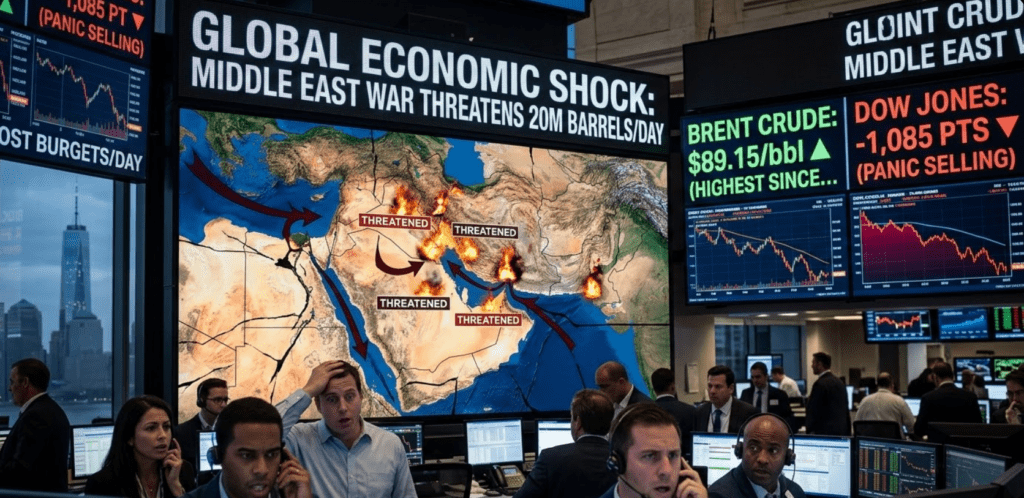
A rapidly escalating war in the Middle East is now colliding with one of the most fragile global economic environments in decades, and the early warning signs of a major financial shock are already beginning to appear.
Most people still see these developments as separate headlines.
But they are not separate at all.
When you connect the dots, a very alarming chain reaction is starting to form.
At the center of this entire crisis is the Strait of Hormuz, a narrow waterway that handles roughly 20% of the entire global oil supply. That works out to about 20 million barrels of oil every single day moving through a corridor only a few miles wide.
When a chokepoint this important becomes unstable, the consequences ripple across the entire planet.
And right now shipping through that corridor is being severely disrupted by the expanding war involving Iran.
Energy markets immediately reacted.
Brent crude has surged to about $89 per barrel, putting it on track for its largest weekly gain since 2020 as traders scramble to price in the possibility of a major supply shock.
Some analysts are already warning that if the conflict continues to escalate, oil could potentially spike toward $150 per barrel, which would send shockwaves through the global economy.
Financial markets are beginning to feel the pressure as well.
The Dow Jones Industrial Average has already experienced massive volatility as investors react to the rapidly worsening situation.
At one point this week the Dow plunged more than 1,200 points, one of the largest single day declines in months.
Even on calmer trading days the index has still been dropping sharply, including a 784 point selloff as the war and inflation fears rattled investors.
Meanwhile energy prices are already beginning to hit consumers.
Gasoline prices have quickly climbed to around $3.25 per gallon, raising fears that inflation could surge again just as central banks were hoping price pressures would ease.
This is the nightmare scenario for policymakers.
War.
Energy shock.
Inflation.
Market instability.
Historically, that exact combination has preceded some of the most severe economic disruptions of the modern era.
And the conflict itself may still be expanding.
Iran has already launched missile and drone attacks across the region as the war spreads beyond its borders, further destabilizing energy markets and international shipping routes.
If tanker traffic through the Persian Gulf continues to stall, millions of barrels of oil could disappear from global markets almost overnight.
And when supply drops suddenly while demand remains high, prices tend to explode.
The modern global economy runs on energy.
Everything depends on it.
Food production.
Manufacturing.
Shipping.
Air travel.
Electricity.
When energy prices surge, the cost of almost everything else begins to rise as well.
Right now we may be watching the early stages of a chain reaction that could grow far larger than most people realize.
A widening Middle East war.
The world’s most important oil chokepoint under threat.
Oil prices surging toward levels not seen in years.
Stock markets already trembling.
Sometimes the biggest economic crises do not begin with a dramatic collapse.
Sometimes they begin with a series of warning signs that most people dismiss at first.
But those warning signs are starting to appear everywhere.
And they are getting harder to ignore.