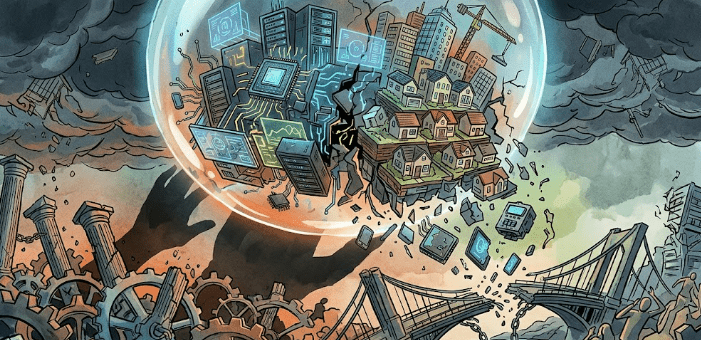
Blue Owl restricting withdrawals in private credit funds tied to AI and software borrowers is not an isolated hiccup, it is liquidity behavior showing up when assets stop feeling liquid, and that is already documented in market reporting. At the same time hyperscalers are projecting roughly $175B in bond issuance in 2026 just to fund AI infrastructure, which means the growth story is increasingly financed by leverage instead of cash flow. Add sovereign debt levels that have pushed developed economies into persistent deficit mode with rising interest burdens and you get a system with less room to absorb shocks from any direction.
The perfect storm:#US national debt over $39 trillion and kicking.
Domestic inflation consistently rising#WTI scratching $105 per barrel #NYSE will continue facing massive losses#OOTT pic.twitter.com/N99CIltIHZ
— Einstein Millan Arcia (@EinsteinMillan) March 30, 2026
US private credit faces potentially higher defaults as software exposure weighs
April 2 (Reuters) – The U.S. private credit industry is staring at a period of higher borrower defaults, several brokerages warned, exposing cracks in what had become one of Wall Street’s favorite trades in recent years.
While the recent stress in the industry is unlikely to trigger a systemic crisis, analysts expect growth to moderate as AI disrupts software companies, which account for a major chunk of private credit portfolios.The latest hit to the industry came after Blue Owl (OWL.N), opens new tab capped the amount investors can withdraw from two of its retail-focused funds, dragging its shares as much as 8.6% to a record low.
Other alternative asset managers, including Apollo Global (APO.N), opens new tab, Blackstone (BX.N), opens new tab, Ares Management (ARES.N), opens new tab, KKR (KKR.N), opens new tab and Carlyle Group (CG.O), opens new tab, also fell between 3.6% and 5.5% earlier in the session.
All of them pared declines sharply as broader markets bounced back following renewed hopes of a reopening of the Strait of Hormuz.
AI‑led software selloff may pose risk for $1.5 trillion U.S. credit market, says Morgan Stanley
Feb 10 (Reuters) – Concerns that artificial intelligence could disrupt large parts of the software industry have started to spill into credit markets, Morgan Stanley warned, as software accounts for about 16%, or $235 billion, of the $1.5 trillion U.S. loan market.
Bond blues hit Big Tech at the worst time
ORLANDO, Florida, March 30 (Reuters) – No borrower will escape the surge in market-based interest rates unleashed by the Middle East war and resulting energy supply shock. But for U.S. tech firms planning to spend over $600 billion this year in the artificial intelligence arms race, spiking borrowing costs could not have come at a worse time.
The AI capex surge is unprecedented. The expected $630 billion in capital expenditure from Big Tech this year, mostly on AI data centers, chips, and cloud computing, is worth more than 2% of GDP. The projected spend of more than $800 billion next year is closer to 3% of GDP.Big Tech historically used cash to fund expansion. And they still have lots of it: some estimates put the big five hyperscalers’ combined cash and equivalent holdings at over $350 billion. That’s partly why Apple (AAPL.O), opens new tab and Microsoft (MSFT.O), opens new tab still enjoy credit ratings higher than those of the U.S. government.
But they’re burning through it.
2026: Between AI boom, debt risks, and new opportunities for Europe
From a macroeconomic perspective, 2026 will be marked by a new normal following the interest rate turnaround and Donald Trump’s return to the White House in early 2025. The combination of a sustained AI investment boom, global key interest rate cuts, and a significantly more expansionary fiscal policy—especially in Europe—will lay the foundation for a stable, albeit moderate, upturn in the global economy.
At the same time, vulnerabilities in the financial system are increasing: rapidly growing private debt markets, high government debt, and highly concentrated valuations in the US stock market.
Trump wants a $1.5 trillion military budget.
It would only cost $45 billion to end homelessness and hunger in the U.S. pic.twitter.com/J92B63hPsg
— Melanie D'Arrigo (@DarrigoMelanie) April 2, 2026
US financial advisors brace for growing array of risks in second quarter
PROVIDENCE, Rhode Island, April 1 (Reuters) – Investment advisors say a buildup of problems is weighing on clients, who are entering the second quarter of the year struggling with trying to predict the outcome of war, the direction of energy prices and the repercussions of problems stemming from private credit.
An exuberant rally that turned the final trading day of the first quarter on Tuesday into the best day of the year so far was not enough to save U.S. market indexes from closing the period with the worst quarterly returns seen since 2022, as the Standard & Poor’s 500 index recorded a 4.6% loss for the first three months.