This conflict is crossing new lines almost every week.
First the targets were military bases.
Then senior leadership.
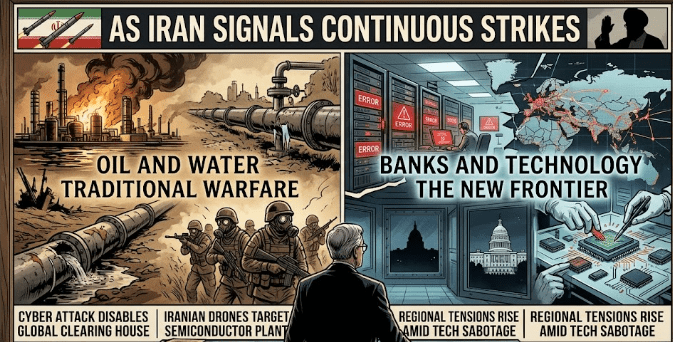
Then oil infrastructure.
Then desalination plants that provide water to millions.
Now the war is moving directly into the financial system.
According to reports circulating overnight, the United States and Israel struck Iranian banking institutions, an escalation that pushes the conflict far beyond traditional military targets.
Iran’s response came almost immediately.
Iranian military command warned that U.S. and Israeli banks and financial centers should expect a painful response.
Officials also issued a direct warning telling civilians in the region to stay at least one kilometer away from American and Israeli banks.
That is a stunning development.
Banks have now been placed on the battlefield.
Iran’s joint military command confirmed that financial institutions are officially on their target list.
The conflict also spilled directly into global shipping lanes.
Reports say Iran struck a Thai ship attempting to pass through the Strait of Hormuz, one of the most critical energy arteries on the planet.
Roughly 20% of the world’s oil supply normally passes through that narrow waterway.
Even small disruptions there can send energy markets into chaos.
But the situation may be about to become much more dangerous.
U.S. intelligence sources say Iran has begun dropping naval mines into the Strait of Hormuz.
Only a few dozen have reportedly been confirmed so far.
But analysts believe Iran possesses thousands more.
If those mines are deployed on a large scale, clearing the shipping lane could take months.
That would effectively turn one of the most important maritime passages in the world into a dangerous maze.
Meanwhile Iranian officials are openly warning about the economic consequences.
A spokesperson for Iran’s Khatam al Anbiya military headquarters warned that oil prices could surge to $200 per barrel if the conflict continues to destabilize the region.
He also issued a direct threat to global energy markets.
Iran will not allow “even one litre of oil” to reach the United States, Israel, or their partners, he said.
Any tanker heading toward those destinations could be treated as a legitimate target.
The escalation does not stop with shipping or energy.
Iranian officials are now warning that facilities connected to major American technology companies could become targets.
Companies specifically mentioned include Amazon, Microsoft, Nvidia, IBM, Oracle, and Palantir.
Those companies operate data centers and infrastructure across the Middle East, including hubs in Dubai and Abu Dhabi.
That means the conflict is now creeping into yet another sector that underpins the modern global economy.
Energy.
Finance.
Technology.
At the same time, security agencies in the United States are reacting to the growing threat.
The FBI has reportedly moved to an elevated alert posture.
The Department of Homeland Security is warning about potential cyberattacks against American financial infrastructure.
Iran does not necessarily need to physically destroy banks to create chaos.
A coordinated cyberattack against financial networks could disrupt payments, trading systems, and digital transactions.
And Iran has spent years building cyber capabilities designed for exactly that kind of operation.
Meanwhile the political leadership driving the conflict appears in no hurry to stop it.
Israel’s defense minister has now declared that the war with Iran will continue without any time limit.
And according to reporting from Reuters, Israeli officials believe the United States is not close to ordering an end to the war.
That means the trajectory of this conflict remains pointed in one direction.
Forward.
Every stage of this war seems to push into a new layer of the global system.
First the battlefield.
Then the oil supply.
Then water infrastructure.
Now banks, technology networks, and financial systems.
The Khatam Al-Anbiya Air Defense HQs warns people in the entire region to stay away for 1km from banks after American-Zionists attacked a Bank Sepah branch in north of Tehran, killing a lot of personnel working extra hours ahead of Persian New Year. pic.twitter.com/JYcAaCQlLI
— Fereshteh Sadeghi فرشته صادقی 🟩 ☫ 🟥 (@fresh_sadegh) March 11, 2026
When wars begin expanding into the core systems that power the global economy, the consequences rarely stay contained to the region where the fighting started.
Energy markets feel it.
Shipping routes feel it.
Financial systems feel it.
And eventually ordinary people across the world feel it as well.
Because once a conflict begins targeting the infrastructure that keeps the global economy running, it stops being just another regional war.