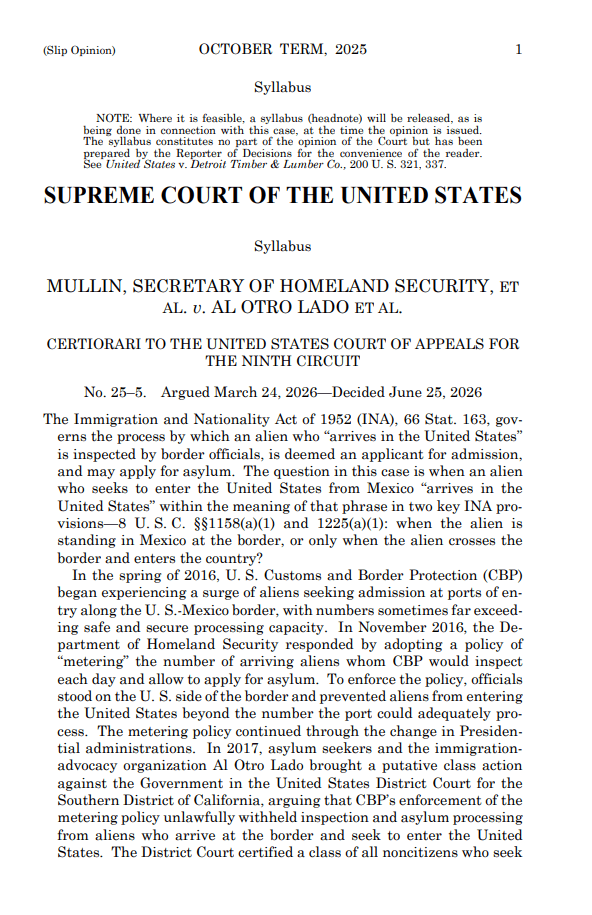
Mullin v Al Otro Lado June 2026
The Supreme Court has handed the Trump administration one of its biggest immigration wins yet.
In a 6-3 ruling, the Court held that migrants waiting on the Mexico side of the border have not legally “arrived” in the United States and therefore do not have the right to demand access to the US asylum process from outside the country.
The decision revives and strengthens the legal foundation behind border metering policies.
Under those policies, border agents can turn people away from ports of entry when facilities are at capacity instead of immediately processing asylum claims.
The ruling means migrants generally must first enter US territory before gaining access to certain asylum procedures.
The decision split along ideological lines, with the Court’s conservative majority siding with the administration while the liberal justices dissented.
The ruling comes alongside separate Supreme Court decisions that have expanded executive authority over Temporary Protected Status programs.
Those decisions give the administration greater ability to end TPS protections for migrants from countries including Haiti and Syria while limiting the ability of lower courts to block those actions.
Taken together, the rulings significantly strengthen executive control over immigration policy.
The practical impact could be substantial.
Border agents will have greater authority to manage processing at ports of entry.
TPS terminations could move forward more quickly.
Deportation efforts may face fewer legal obstacles.
The larger story is that the legal ground beneath US immigration policy is shifting.
For years, many of these policies were tied up in court battles.
The Supreme Court is increasingly siding with the executive branch, giving the administration more room to enforce a tougher border strategy.
That could make this summer one of the most consequential periods for immigration enforcement in years.