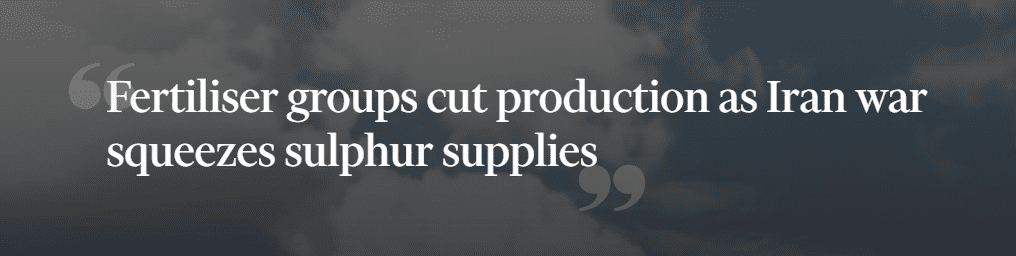
The closure of the Strait of Hormuz has triggered a systemic fertilizer supply shock detailed by the FAO and energy reporting, as well as Oilprice.
Roughly 30 to 34 percent of global fertilizer exports and 50 percent of global sulfur trade were dependent on this maritime chokepoint before the blockade began in February 2026.
Global urea prices have surged more than 50 percent since the start of the conflict, creating a prohibitive cost barrier for commercial farmers.
Phosphate production in the US and Brazil has been curtailed as soaring sulfur costs render processing margins negative according to recent commodity analysis.
The disruption has moved from a logistical bottleneck to a structural depletion of nutrients, forcing farmers to reduce fertilizer application rates to survive.
Global agricultural output is now tethered to the diplomatic outcome of a naval blockade rather than biological or seasonal cycles.
Nations are increasingly adopting protectionist export bans to secure domestic supply, effectively dismantling the global trade framework for essential crop nutrients.
The system is transitioning from high-efficiency global supply toward a fragmented regionalized survival model where caloric output is sacrificed to mitigate immediate cost spikes.
Even if the Strait were to reopen tomorrow, the lost procurement window has already baked in a reduced fertilizer application rate for the 2026 and 2027 harvest cycles.
How will the international agricultural system prevent a systemic food security collapse when the cumulative deficit in nitrogen and phosphate inputs forces a widespread reduction in staple crop volumes?