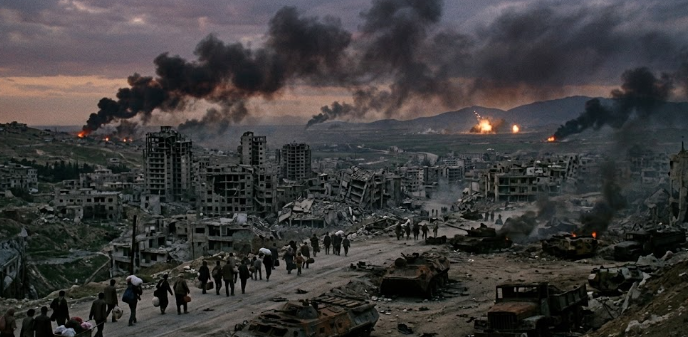
A single military strike today has pushed this conflict far beyond containment. Israel announced it killed Ali Larijani, Iran’s top national security official, and Gholamreza Soleimani, commander of the Basij militia in overnight airstrikes. Larijani was deeply involved in military planning and diplomatic relations with Gulf states. His elimination means Iran’s strategic command just lost its axis of coordination.
This is not a sideline assassination. It is the first time since the start of this war that Iranian officials of such stature have been confirmed killed. Conservative counts already put total deaths across Iran, Lebanon, Israel, Iraq and Gulf states at over 2,000. Reuters
Iran’s new supreme leader publicly rejected all de-escalation proposals. He declared peace is impossible until the United States and Israel are brought to their knees. This is not diplomacy. It is a declared war posture. Reuters
Drones and rockets struck the U.S. Embassy in Baghdad, igniting a fire in one of the most intense attacks so far, as regional strikes also hit sites across Iraq, the UAE, Lebanon, Iran, and Israel amid escalating tensions. pic.twitter.com/2jy07ZgIUG
— TVP World (@TVPWorld_com) March 17, 2026
Iran's Revolutionary Guards warn US companies will be attacked as they issue list of 15 targets with employees urged to evacuate across Middle East https://t.co/MWizbJ3mH0
— Daily Mail US (@Daily_MailUS) March 17, 2026
According to DailyMail:
Iran’s Revolutionary Guards have threatened to target as many as 15 US companies across the Middle East calling on employees to evacuate the sites.
The IRGC warned that facilities related to those corporations could be in danger as the war between Iran and the United States and Israel continues into its third week.
‘We warn the American regime to evacuate all American industries in the region. We ask people living near industrial factories in which Americans hold shares to leave those areas so they are not harmed,’ said the Guards in a statement obtained by Drop Site News.
A graphic being circulated by the IRGC lists some of the companies that would be affected, including ExxonMobil, Boeing, Microsoft, Lockheed Martin and Amazon Web Services.
It comes as Iranian officials have allegedly tried to reestablish diplomatic contact with Donald Trump’s Middle East envoy, Steve Witkoff.
The President, however, has no interest in negotiating with Tehran, senior White House officials told CNN.
Iran blows up another Tanker in the Strait of Hormuz. pic.twitter.com/XSGMgs19cD
— Trading With Logic (@Tradewith_kd) March 17, 2026
Iranian drones struck the Fujairah oil hub in the UAE multiple times. Fires broke out and operations were disrupted at one of the world’s most critical oil transshipment points outside the Strait of Hormuz. Al Jazeera
The Strait of Hormuz remains effectively closed. This waterway normally handles close to twenty percent of global oil flows every single day. Shipping traffic has fallen to near zero. Merchant vessels are damaged. Seafarers were killed or evacuated. One tug was sunk. Wikipedia
Oil markets reacted instantly. Brent crude is trading above one hundred and three dollars per barrel today. That is roughly fifty percent above prewar levels. Facilities in the UAE and Iraq were disrupted, halting well over one million barrels per day of combined exports. A major Gulf natural gas field was struck and output has been slashed. Europe’s gas benchmark jumped about three percent. The Guardian
Mohamed El-Erian warned markets are shifting from short disruption to long term structural damage to oil supply. He said higher oil prices will mean persistently higher interest rates, lower growth, higher unemployment and a greater risk of financial instability.
"We risk going from short-term disruption to long-term structural damage to the oil market," @elerianm tells me. "The increase in the oil price is going to persist for a while and that is going to mean not only higher interest rates, but lower growth, higher unemployment and a… pic.twitter.com/acjlFsKrLL
— Christiane Amanpour (@amanpour) March 16, 2026
Markets are not calm. Analysts say the Strait of Hormuz disruption is the largest energy supply shock since the 1970s energy crisis. Crude spiked to nearly one hundred and twenty six dollars per barrel at its peak before settling. Major shipping firms have stopped using key export routes. Wikipedia
Civilian war has become commercial war. Airlines are canceling routes. Oman Air suspended flights to nine cities through March thirty first due to airspace restrictions tied to the war. Times of India
Israel says it has won the war, but key objectives remain unmet. The conflict will continue until Iran’s strike capabilities are degraded and internal political change occurs. This is not containment. This is open-ended conflict. Reuters
Every percentage point in oil price matters. Right now those percentages are moving markets, inflation expectations and fiscal policy discussions in capitals around the world. Gulf export flows have been cut by over one million barrels per day. Energy hubs are repeatedly hit by drone attacks. Air travel routes are canceled. Crude prices remain volatile. This is verified structural damage to global energy supply.
This war is not fading. Iranian missiles and drones are hitting civilian areas in Jordan, Iraq and the Gulf. Merchant ships and tankers are sitting idle. Crude and gas are at multi-month highs. These are precise, measurable impacts on energy, transport and finance, not abstract risks.
🚨 JUST IN: Kevin Hassett reveals President Trump under NO CIRCUMSTANCES is going to "back down"
Q: Does this mean regime change, keeping the strait open?
HASSETT: "He will decide. He wants to make sure Iran can't harm neighbors or US EVER AGAIN." 🔥pic.twitter.com/lR58hKiG86
— Eric Daugherty (@EricLDaugh) March 17, 2026
Gasoline $5 / gallon soon due to the war in Iran ? The longer it lasts, the more probable it will be $5 pic.twitter.com/8aB88fTLM9
— Data Driven Stocks (@stockdatamarket) March 17, 2026
Iran has rejected all offers of negotiation and potential peace it looks like they could be preparing for an extended conflict…
— WarMonitor🇺🇦🇬🇧 (@WarMonitor3) March 17, 2026
🚨DUBAI REAL ESTATE DOWN 60% pic.twitter.com/snPHoPevoQ
— Casey Donaldson (@caseyjdonaldson) March 17, 2026