By Peter Reagan
Human beings may be the most naturally argumentative species on the planet. If there is something that can be debated, someone will almost certainly take the opposite side.
Sometimes those disagreements are minor and harmless. Other times, they involve major decisions that can affect families, businesses and entire communities. For better or for worse, disagreement is a normal part of how we evaluate information and make decisions.
Disagreement is not necessarily a bad thing. When we are willing to listen to one another and examine our assumptions, disagreement can reveal important insights and lead to better conclusions.
Some debates, however, are especially difficult because the available evidence supports more than one interpretation. And that’s exactly what’s happening in the U.S. economy right now…
Economic experts can’t agree on this
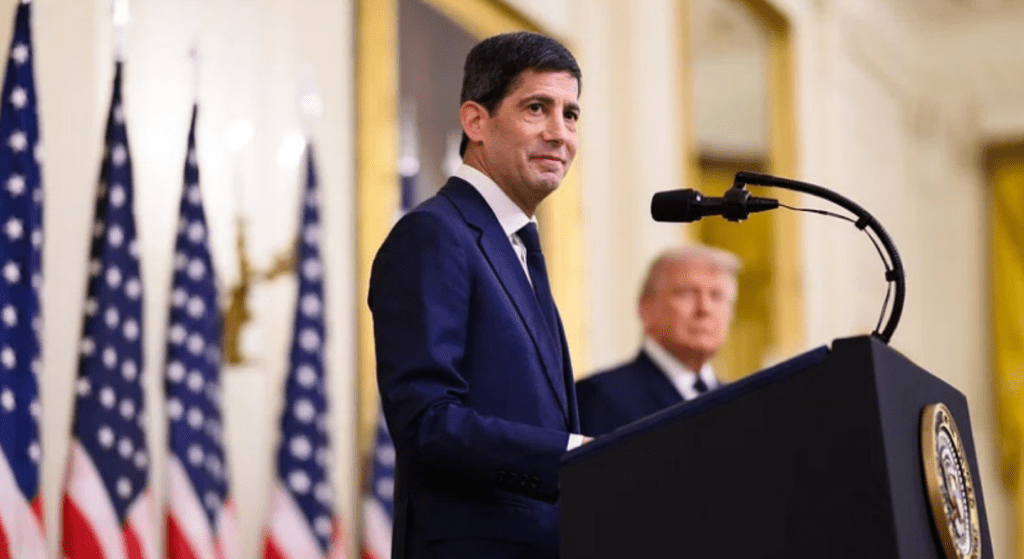
The debate has intensified following the Federal Reserve’s unanimous decision to leave interest rates unchanged this week. At the same time, Fed Chair Kevin Warsh indicated that future policy will depend heavily on incoming economic data (rather than a bias toward lower rates, as previously signaled after their March meeting). That has left economists scrutinizing every jobs report, inflation reading and consumer spending update for clues about what comes next.
In fact, the Fed’s Open Markets Committee (FOMC) doesn’t exactly have a clear view either. The Fed’s most recent Summary of Economic Projections shows that fully half of the committee think interest rates will go up before the end of the year.
The other half think the opposite. In fact, they’re looking at the same data points and arriving at very different conclusions about where the U.S. economy is headed next.
To be fair, recent economic reports have painted a complicated picture. Inflation has cooled from its peak but remains above the Fed’s long-term target. Unemployment remains relatively low, yet job openings have declined from previous highs. Consumer spending has remained resilient, even as credit card balances and delinquency rates have risen.
Some see this as signs of continued growth and resilience.
Others see evidence that economic conditions are weakening and that a slowdown may be approaching.
For families, these debates are not merely academic. Interest rates affect mortgage costs, auto loans, credit card debt, savings account yields and retirement savings. The direction of the economy can influence everything from job opportunities to the dollar’s purchasing power.
If economic growth remains strong, inflationary pressures can persist. Historically, the Federal Reserve has often responded to elevated inflation by raising interest rates in an effort to slow demand and stabilize prices.
Conversely, if economic activity weakens significantly, the Fed may lower interest rates to encourage borrowing, investment and spending.
Neither outcome would be unusual. Both have occurred many times throughout modern economic history.
The challenge today is that the economy is producing signals that support both forecasts.
For example, economist Christopher Hodge argued that wage pressures appeared subdued and that businesses might have less ability to pass higher costs on to consumers. If he’s right about that, it would mean slower price growth – a welcome development that could support lower interest rates in the future.
At the same time, other economists cited by the Associated Press pointed to improving hiring trends and ongoing inflation concerns as reasons the Federal Reserve could maintain a tighter policy stance.
Importantly, the existence of these competing views does not necessarily mean one side is wrong, or acting in bad faith. If you’re a regular reader, you’ll know I’m quite frequently wrong in my own forecasts. Here’s the thing: Economics is inherently difficult because economies are incredibly complex systems influenced by millions of individual decisions, while government policies, global events and changing financial conditions constantly fluctuate.
Even reasonable, well-informed and reliable experts can examine the same information and reach very different conclusions.
That doesn’t mean they’re wrong. Rather, it means there’s only one correct answer and millions of wrong answers.
For you, though, this can create a frustrating question: If the experts disagree, what should I do?
So, which viewpoint should you believe?
The honest answer is that no one can know with certainty which forecast will ultimately prove correct.
Economic forecasts are estimates, not guarantees. Even highly respected economists and institutions routinely revise their outlooks as new information becomes available.
Rather than trying to predict which economist will be proven right, investors may benefit from focusing on the one thing both sides implicitly agree on: the future remains uncertain.
The most important signal may not be whether growth accelerates or slows. It may be the fact that even experienced economists cannot confidently agree on which path lies ahead.
Economic conditions continue to evolve. Inflation, employment, consumer spending, government policy and global developments are all changing simultaneously. As a result, investors and policymakers alike are navigating an environment where future outcomes are less predictable than many would prefer.
Volatility is not unusual. In fact, it is a recurring feature of financial markets and economic cycles.
While volatility can create anxiety, it can also create opportunities. The key is having a financial strategy that is designed to withstand a range of possible outcomes rather than relying on a single economic forecast being correct.
As Thrivent noted in a recent discussion of economic volatility:
“Most of all, remember that volatility is part of financial planning. A good plan helps you ride out the bumps without locking in losses.”
That principle reflects a widely accepted concept in financial planning: diversification can help reduce risk by spreading exposure across different asset classes rather than concentrating everything in one area.
For many investors, that means building a portfolio designed to preserve purchasing power and remain resilient across different economic environments.
When future economic conditions are difficult to forecast, many investors look for assets that have historically performed differently from the most common financial assets. That search for diversification is one reason precious metals often attract attention during periods of uncertainty. If you’d like to learn more about gold’s historical role as a store of value, discover why investors choose physical gold.
And if you’d like to discuss whether precious metals may fit your personal financial goals and circumstances, you can speak with a Birch Gold specialist at (877) 749-7738.
History suggests that major market surprises often occur when consensus expectations prove wrong. Because forecasts can change quickly, I think it’s wise to focus less on predicting the future and more on preparing for any possible outcome.