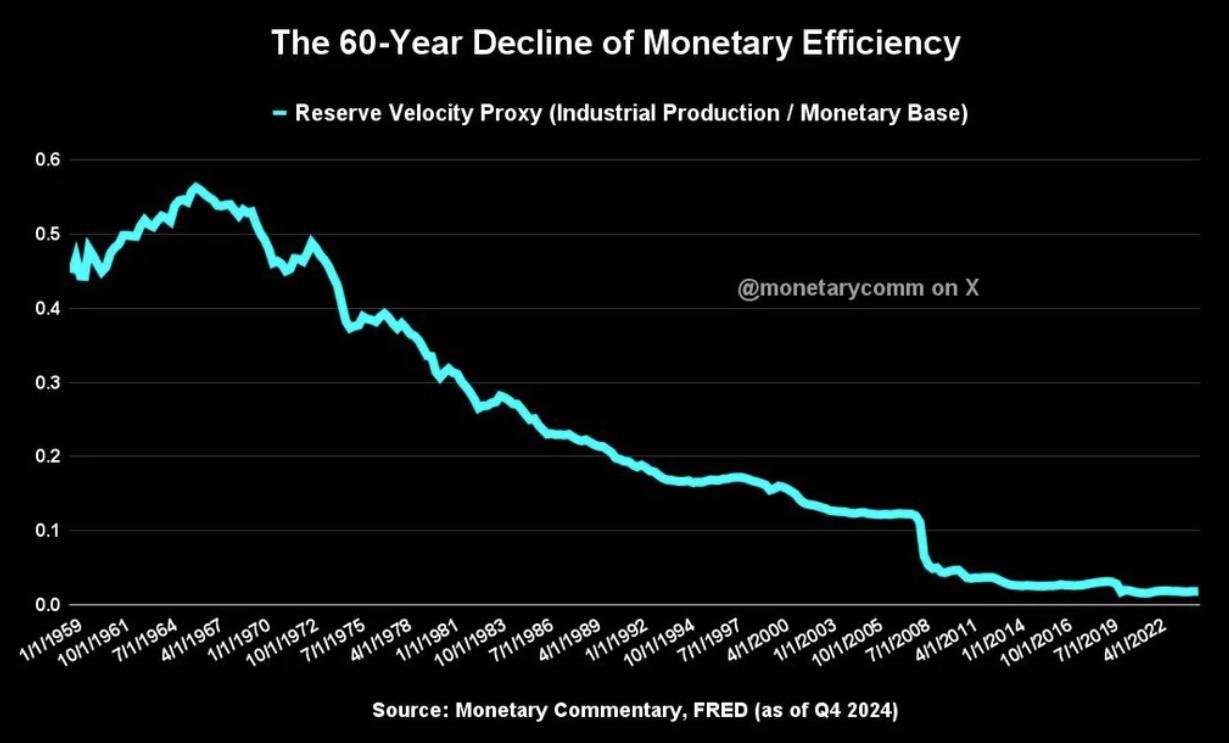
Here’s a visual on the structural decay of monetary transmission over six decades, a phenomenon obscured by nominal aggregates but laid bare by the steady collapse of reserve velocity.
From a peak near 0.55 in the mid-1960s, the ratio of industrial production (seasonally adjusted) to monetary base (not seasonally adjusted) has dropped with almost uninterrupted persistence. This long descent reflects a profound #macro shift: central banks have increasingly injected reserves (i.e., fake #money) that fail to catalyze proportional real output, signaling a growing dislocation between #liquidity creation and productive capacity.
The steep post-GFC collapse — and its failure to mean-revert post-COVID — suggests the monetary base has become structurally inert, absorbed into financial plumbing rather than mobilized into productive lending or investment.
This trajectory marks the transition from monetarist effectiveness to liquidity saturation, where marginal dollars of base money increasingly serve as collateral or excess reserves rather than engines of growth.
The implication is stark: monetary policy has become less about stimulating real activity and more about stabilizing a financialized ecosystem increasingly decoupled from the physical #economy.