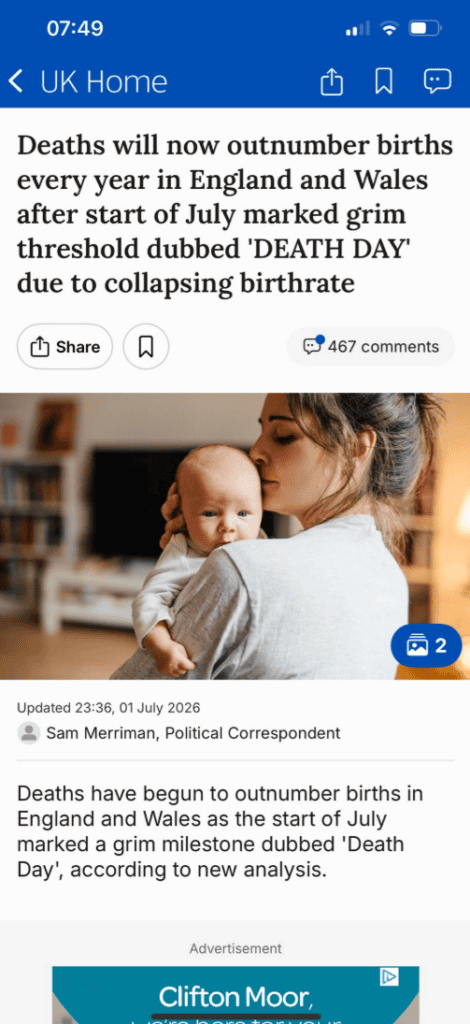
ONS projections show England and Wales reaching a turning point in 2026 where deaths are expected to begin exceeding births on a sustained basis for the first time in decades.
The projection estimates around 584,000 births versus 588,000 deaths in 2026 to 2027, marking the start of a period where natural population change turns negative.
Over the next decade, the gap is projected to widen to roughly 450,000 more deaths than births.
The shift is driven by persistently low fertility rates, now estimated around 1.39 children per woman, well below replacement level.
Actual 2025 data still shows a slight excess of births over deaths, but the margin has been narrowing steadily as long term demographic trends take hold.
Despite this, overall population growth is still expected to continue due to net migration, which offsets the natural decline.
Think tank analysis has highlighted July 1 2026 as a symbolic “Death Day” reflecting the moment annual projections flip into negative natural change.
Similar patterns are already visible across much of Europe, where aging populations and low fertility rates are reshaping labor markets, welfare systems, and long term fiscal pressures.
The underlying issue is structural rather than cyclical.
Fewer births combined with longer life expectancy gradually shifts the population balance toward older age groups, increasing dependency ratios and pressure on public services.
Without sustained changes in fertility trends or policy offsets, the trajectory points toward long term demographic aging and reliance on migration to stabilize population levels.
Centre for Social Justice analysis: https://www.centreforsocialjustice.org.uk/newsroom/death-day
Daily Mail article: https://www.dailymail.com/news/article-15945675/Deaths-outnumber-births-year-England-Wales-July-DEATH-DAY-birthrate.html
ONS births 2025 data: https://www.ons.gov.uk/peoplepopulationandcommunity/birthsdeathsandmarriages/livebirths/bulletins/birthsummarytablesenglandandwales/2025