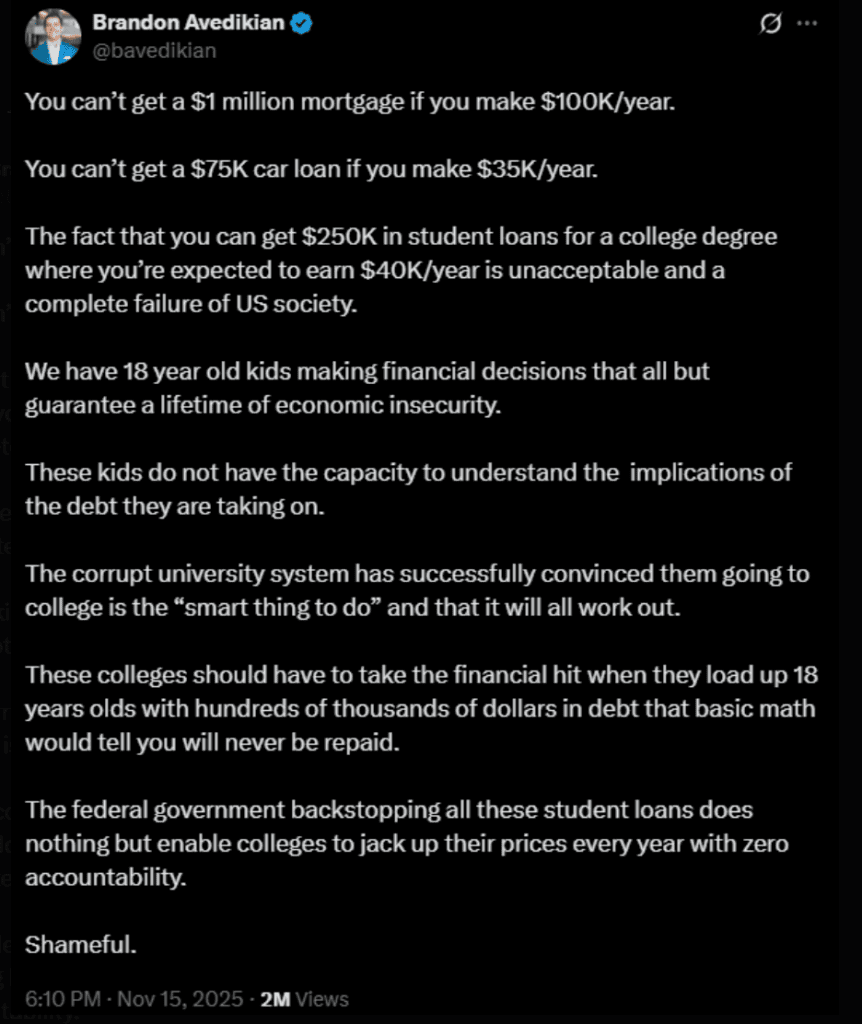
We’re handing people in their early 20s the ability to borrow more than $200,000 for a degree, then telling them that if it all goes wrong, bankruptcy isn’t an escape hatch.
Think about how unusual that is. Most lenders spend a lot of time figuring out whether someone can actually repay a loan. Here, huge amounts of debt can be taken on by people who often have little financial experience, with the expectation that everything will work out because they have a college degree.
But what happens when the degree leads to a job paying around $40,000 a year?
That’s where the math starts looking ugly. A six figure debt backed by a middle income salary can follow someone for years, delaying buying a home, starting a family, saving for retirement, or taking career risks. The loan doesn’t care whether the degree delivered the return that was promised.
The part that stands out to me isn’t just the size of the loans. It’s the incentive structure. Colleges get paid upfront. The student takes the risk. Taxpayers ultimately back much of the system. If the education doesn’t translate into earnings, the borrower is the one left carrying the weight.
Not every expensive degree ends this way, and plenty of graduates do very well. But a system that routinely allows young adults to accumulate over $200,000 in debt while offering no bankruptcy safety valve deserves a lot more scrutiny than it gets.
At some point, you have to ask whether we’re financing education or simply normalizing a lifetime of debt.