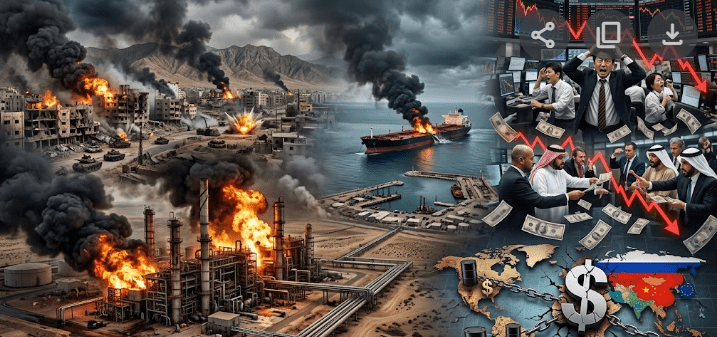
Something extremely dangerous may be forming in global markets, and most investors have not processed it yet because it happened while markets were closed.
The escalation began when U.S. strikes reportedly targeted Kharg Island, the facility responsible for roughly 90 percent of Iran’s oil exports. At the same time, shipping activity through the Strait of Hormuz collapsed. According to analysts monitoring tanker traffic, shipping through the strait temporarily fell to zero.
That matters because the Strait of Hormuz is one of the most important energy chokepoints on the planet. Roughly 20 percent of global oil supply passes through that narrow corridor between Iran and Oman. When that flow stops, the shock does not stay in the Middle East. It spreads instantly through global energy markets.
Traders are already beginning to price a much larger disruption. As macro strategist Bob Elliott noted on Twitter, the oil futures curve is now pricing a far more extended shock than what markets saw during the 2022 energy crisis. December contracts are pricing oil roughly 40 percent higher into the end of 2026 compared with about $60 oil at the start of this year.
The oil curve is now pricing in a far more extended oil shock than what we saw in '22. Dec contracts now pricing oil 40% higher to end '26 relative to the 60 bucks to start the year. pic.twitter.com/8JQZ3ZxJl6
— Bob Elliott (@BobEUnlimited) March 15, 2026
That tells you something important. Energy markets are no longer assuming this conflict ends quickly.
But the oil shock is only the first layer of risk.
The second layer is now emerging in the global currency system.
According to Twitter user @SuburbanDrone, the strength of the U.S. dollar during the conflict has pushed the Japanese yen toward levels that may force the Bank of Japan to intervene in the foreign exchange market. The last time the BOJ intervened to defend the yen was in July 2024, during a period when violent currency movements triggered a major unwind in global risk assets.
Here is where it gets interesting:
The war has strengthened the dollar to the point that the BOJ is planning to intervene in the FX markets to bolster the Yen.
The last time there was BOJ currency intervention was July 2024 which is when the AI bubble imploded the first time:… pic.twitter.com/EvBcgLRDwH
— Mac10 (@SuburbanDrone) March 15, 2026
That matters because the Japanese yen sits at the center of one of the largest leverage trades in global finance.
For decades investors have borrowed extremely cheap yen and deployed that money into higher yielding assets across the world. This structure is known as the yen carry trade. When the yen suddenly rises or when the BOJ intervenes in currency markets, that entire trade can unwind rapidly.
And when the carry trade unwinds, money leaves global risk markets at the same time.
In other words, a currency intervention in Japan can trigger a global risk off event that hits equities, crypto, credit markets, and emerging markets all at once.
But the third development may be the most explosive of all because it directly challenges the foundation of the global financial system.
According to analysis circulating from Twitter user @DeFiTracer, Iran may allow oil tankers to pass through the Strait of Hormuz only if the oil trade is conducted in Chinese yuan rather than U.S. dollars.
🚨 NEXT WEEK WILL BE TERRIBLE FOR MARKETS!!
Iran has decided to reopen the Strait of Hormuz.
BUT WITH ONE CONDITION.
THE WHOLE WORLD abandons the US Dollar.
Iran is considering allowing oil tankers to pass through the Strait of Hormuz.
BUT oil trade must occur not in US… pic.twitter.com/5O14yJmbNq
— ᴛʀᴀᴄᴇʀ (@DeFiTracer) March 15, 2026
At first glance that may sound like a technical detail.
It is not.
Since the 1970s most global oil trade has been priced in dollars. That structure created what became known as the petrodollar system. Because energy is the most important commodity in the world economy, countries everywhere needed dollars to buy oil. That forced central banks to hold massive dollar reserves and strengthened the global dominance of the U.S. currency.
Now imagine what happens if even a portion of oil flowing through the most important energy chokepoint on earth begins demanding payment in another currency.
China already buys large volumes of Iranian oil, and many of those transactions are already settled in yuan. At the same time Beijing has been aggressively expanding its own cross border payment infrastructure to reduce dependence on the Western financial system.
If a major oil transit route begins requiring yuan settlement, the consequences extend far beyond energy markets.
Central bank reserves begin adjusting.
Currency markets begin repricing.
Global finance slowly adapts to a system that no longer revolves entirely around the dollar.
None of this guarantees the sudden collapse of the dollar. But it shows how geopolitical conflict can evolve into financial conflict.
And that is why the current moment is so dangerous.
A military escalation is threatening one of the most important oil supply routes in the world. Energy markets are beginning to price a prolonged supply shock. Currency markets are approaching the kind of volatility that can trigger a global carry trade unwind. At the same time, the rules of global oil payments may be quietly shifting toward a system that challenges the dollar itself.
Individually each of these developments would be significant.
Happening together, they could reshape global markets far faster than most investors expect.
And the market has barely begun to react.