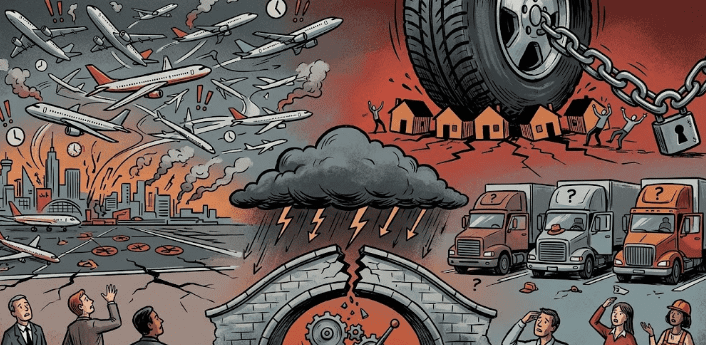
Something strange is happening across the American economy right now.
Not one single dramatic collapse. Not one headline catastrophe.
Instead, pressure is building in several completely different corners of the system at the exact same time. Transportation. Consumer debt. Labor shortages. Monetary policy.
Individually these developments might look manageable. But when you line them up together, they begin to reveal something much more troubling.
Let’s start with something millions of Americans experience every year.
Flying.
Air travel in the United States is becoming more expensive and more frustrating, and industry leaders are warning that the problems could intensify if airport staffing shortages continue. According to reporting on flying in America getting more expensive and less enjoyable, the travel system is under increasing strain as costs rise and operational pressures spread across airlines and airports.
Airline executives are already warning about potential disruptions if security staffing continues to shrink. Several industry leaders sounded the alarm in coverage about airline CEOs warning of possible airport chaos, explaining that staffing shortages at security checkpoints could cause long delays as travel demand surges.
The staffing issue is not theoretical. It is already happening.
During previous government shutdown disruptions, more than 300 TSA officers quit their jobs, and the nationwide unscheduled absence rate climbed to about 6%, roughly double the normal rate near 3%. Those kinds of numbers can quickly ripple through the entire airport system. Coverage examining the situation around TSA absences doubling and hundreds of agents quitting described how long security lines can stretch for hours when staffing collapses.
When security checkpoints slow down, the entire aviation network begins to jam.
Flights get delayed.
Passengers miss connections.
Airlines lose money.
And ticket prices rise even more.
But the transportation strain does not stop at airports.
A major policy change affecting truck drivers could create another shock inside the logistics system.
According to reporting on the cancellation of commercial licenses for immigrant truck drivers, thousands of drivers may lose their ability to legally operate commercial vehicles as licenses expire or enforcement increases.
This comes at a time when the trucking industry already faces a severe labor shortage. Industry estimates suggest the United States currently needs about 80,000 additional drivers to keep freight moving smoothly. Previous analysis examining the shortage around commercial license cancellations for immigrant drivers warned that removing large numbers of drivers from the workforce could tighten freight capacity even further.
And when freight capacity tightens, transportation costs rise.
Those costs eventually show up everywhere.
Food.
Clothing.
Construction materials.
Almost everything Americans buy moves on a truck at some point.
But transportation pressures are only part of the story.
American consumers are also struggling under one of the most punishing financial burdens in the modern economy.
Car payments.
Monthly auto loan costs have surged so high that many households now feel vehicle ownership slipping out of reach. Financial coverage discussing high car payments making ownership feel impossible points to a dramatic shift in affordability.
Average monthly payments for new vehicles have climbed above $700, while used car payments frequently exceed $500 per month.
Those numbers would have been shocking just a generation ago.
Today they are becoming normal.
And that brings us to the final pressure point quietly building in the background.
Interest rates.
For months financial markets assumed the Federal Reserve would soon begin cutting rates to relieve pressure on borrowers. But economists are increasingly warning that those expectations may be premature. Analysis examining the question of whether rate cuts are now off the table suggests the Fed may keep borrowing costs elevated longer than investors expected.
If that happens, millions of Americans remain stuck in a painful financial squeeze.
High car payments stay high.
Credit card interest remains punishing.
Mortgage rates remain elevated.
Businesses continue paying expensive borrowing costs.
Now step back and look at the pattern forming.
Airports struggling with staffing shortages.
Truck driver supply tightening.
Transportation costs rising.
Consumers drowning in debt.
Interest rates staying high.
Each of these developments alone might look like a manageable problem.
But together they describe an economy where pressure is building in multiple critical systems at the same time.
Transportation.
Consumer credit.
Labor supply.
Monetary policy.
And when several parts of the economic machine begin grinding under pressure simultaneously, the consequences can spread faster than most people expect.
Travel becomes harder.
Goods become more expensive.
Debt becomes heavier.
And millions of Americans begin to realize something uncomfortable.
The so called golden era economy suddenly does not feel so golden anymore.