Veronica Martinez woke up early one recent morning to make a fresh batch of cookies. She packed them in a box and headed to a community center in East Oakland, where a nonprofit called Trybe invites families to get the things they need — produce, milk, eggs and even diapers.
Most of the families set up appointments first, but Martinez didn’t have one, so she shared the box of homemade cookies with staff in exchange for access to the pantry.
“They do a lot of hard work, you know, and I appreciate the community for helping us out,” Martinez said.
The longest-ever federal government shutdown delayed Martinez’s monthly food benefits, and she needed help to feed herself and her teenage son and daughter.
“When [the shutdown] happened, wow, it was a shock because I only get paid once a month, and that money goes right away to bills, rent and whatnot, and then the rest I had to save for groceries,” Martinez said. “This month I didn’t even pay my rent on time.”
A Surprise When Your Package Arrives: You Have to Pay the Tariff
The end of a tariff exemption on goods worth $800 or less has left some U.S. shoppers with an extra shipping bill that must be paid before delivery.
Kim Batten, a physical therapist from Oakland, Calif., bought a trench coat earlier this year from a Dutch retailer for $456, a price that was a little above her budget.
But after the coat was shipped, UPS told Ms. Batten in an email that she would have to pay over $250 in customs duties to receive it. With shipping, the whole transaction came to well over $700.
“It ended up being the second most expensive article of clothing I’ve ever bought, other than my wedding gown,” she said.
For decades, no customs duties were imposed on items like Ms. Batten’s coat. But this year, President Trump closed a loophole that had allowed goods worth $800 or less to enter the United States tariff free. The loophole, known as the de minimis exemption, ended for items from China in May and for the rest of the world in August. Shoppers must now pay duties for the first time, often in amounts far higher than they expected.
“I’m definitely more leery about where I’m shopping now,” Ms. Batten, 35, said.
Democrats and Republicans favored ending the exemption on low-value goods. They said it helped large sellers, particularly those from China, evade tariffs, and made it easier to smuggle fentanyl into the country. Other countries are now planning to end or tighten de minimis exemptions.
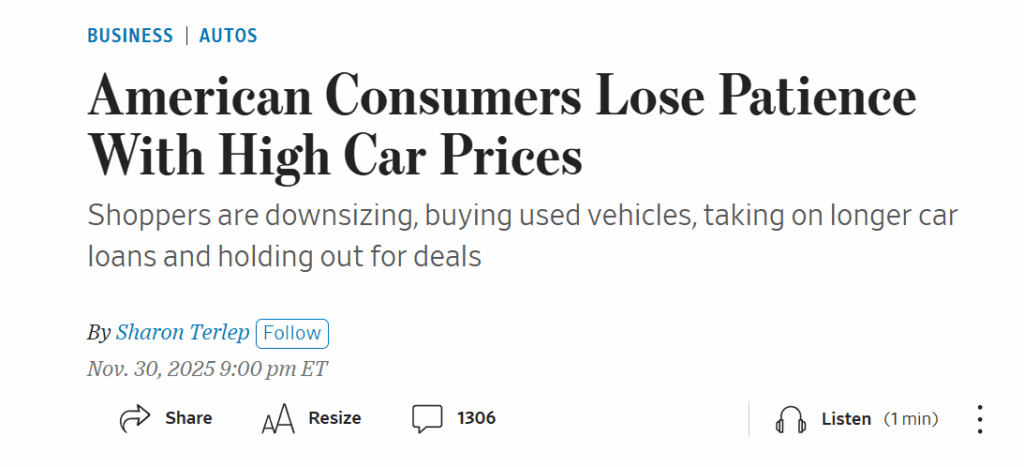
For years it has seemed no sticker price was too high for American car buyers. Even as average new car prices approached $50,000 this year, dealers fretted more over depleted inventories than losing customers to sticker shock.
Those days are coming to an end.
Increasingly stretched consumers are starting to draw the line on what they will pay for a new car, according to dealers, analysts and industry data.
Car buyers are downsizing, buying used vehicles, taking on longer car loans and holding out for deals.
https://www.wsj.com/business/autos/american-consumers-have-had-it-with-high-car-prices-0eb23424
The US housing market could face a price correction ‘worse than 2008’ with prices dropping by half in mere months, a housing analyst has warned.
Melody Wright expressed her fears about plummeting home prices in a recent interview with Adam Taggart on the Thoughtful Money podcast.
The two were discussing a recent Zillow report that found home values are falling for more than half of America, the biggest share since the country was still clawing its way out of the Great Recession.
Data showed that 53 percent of US homes have lost value over the past year, the highest level since 2012, when the housing crash finally hit bottom.
Wright warned that this statistic indicates the housing market is set for a price correction worse than the one in 2008 that burst the housing bubble.
‘I think we’re going to correct all the way to a point where household median income matches the home price, the median home price,’ she said.
‘So that is going to be worse than 2008. This could devolve a lot faster than last time.’
She explained that homes have lost value in 2025 since the pandemic era housing market boom because people are not buying at the same rate.
This is heading straight for a massive collapse and no one’s stopping it. Feels like the worst is still coming.