via WSB
A reverse split is what a dying stock does to stay listed. You smash 10 shares (or 100) into 1 so the price clears Nasdaq’s $1 minimum and the exchange doesn’t kick you off. It fixes nothing about the actual business. It just resets the countdown.
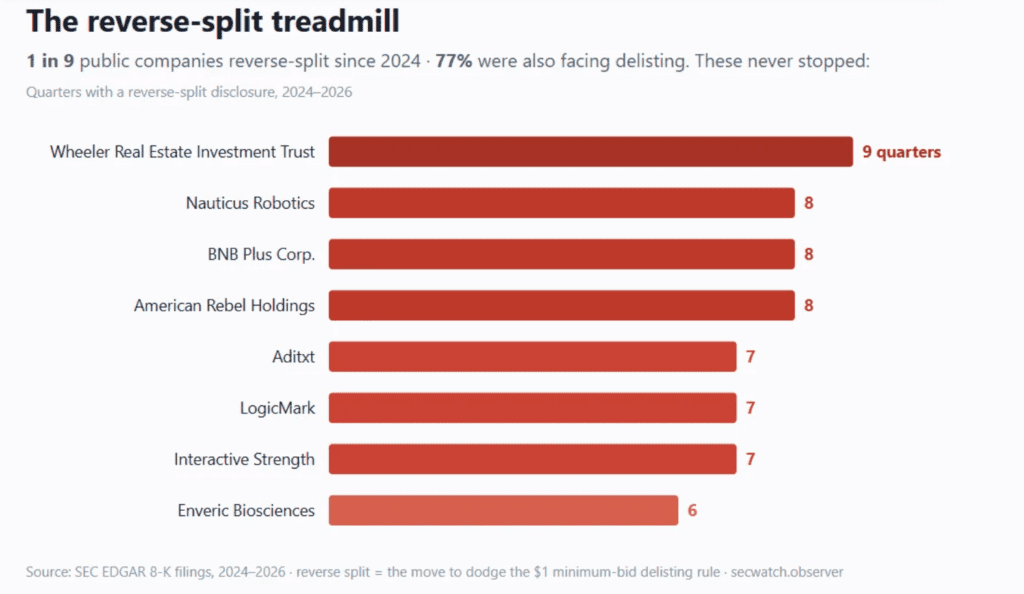
I track every SEC 8-K in a database. Since 2024, about 900 companies did a reverse split. That’s 1 in 9 of everyone who filed an 8-K. And 77% of them also got a delisting or deficiency notice, so it’s not exactly a mystery what’s going on.
There’s a lot of repeat offenders. A bunch of these kept filing reverse-split paperwork across 6 to 9 separate quarters in two years:
– Wheeler Real Estate Investment Trust: 9 quarters
– Nauticus Robotics, BNB Plus, American Rebel: 8 each
– Aditxt, LogicMark, Interactive Strength: 7 each
– Enveric Biosciences: 6
A reverse split doesn’t change what the company is worth, just how many shares you’re holding. So unless the actual business turns around, the price usually drifts back under a dollar within a few months and they have to do it all over again. That’s the treadmill. Some of these ran a 1-for-10, then a 1-for-20, then a 1-for-50 back to back, and the chart still points straight at the floor.
The same companies tend to be selling new stock at the same time, so the share count balloons right after they crushed it down. Investors eat the dilution, they buy themselves a few more months of staying listed.
Splitting again and again and still sitting under a buck is about as loud as a melting-ice-cube signal gets. Which of you degens have actually bought any of these stocks?
Source: SEC EDGAR 8-Ks, 2024 to 2026.