The dangerous part of the U.S. and Iran conflict is no longer the question of whether another strike happens.
It is whether either side still has a realistic path back.
Nine consecutive nights of U.S. airstrikes have pushed the conflict into a cycle where every attack creates another reason for retaliation.
U.S. forces have continued striking Iranian targets, including locations linked to command operations, air defenses, and drone capabilities.
But the response from Iran has expanded the battlefield.
A third U.S. service member was killed in Iraq after a drone detonation involving unexploded ordnance from an Iranian attack.
The death toll among U.S. forces continues rising as American personnel remain exposed across the region.
Then Iran retaliated with missile launches toward Bahrain and Kuwait, targeting areas connected to U.S. military and naval operations.
That escalation matters because Bahrain and Kuwait are not distant from the main pressure point.
They sit inside the Gulf region where the U.S. military maintains a major presence.
The conflict is moving closer to the world’s energy artery.
The Strait of Hormuz.
Shipping traffic through the Strait has effectively stalled as companies reassess the risk of moving through one of the most important waterways on earth.
Two oil tankers exploded or became immobilized while attempting southern transit routes.
One tanker was reportedly disabled after warnings and intervention from U.S. forces.
The market immediately understood what was happening.
The issue was no longer just missiles hitting military targets.
The issue was whether the conflict could disrupt global energy flows.
Brent crude surged above $90 per barrel as traders priced in supply disruption risks.
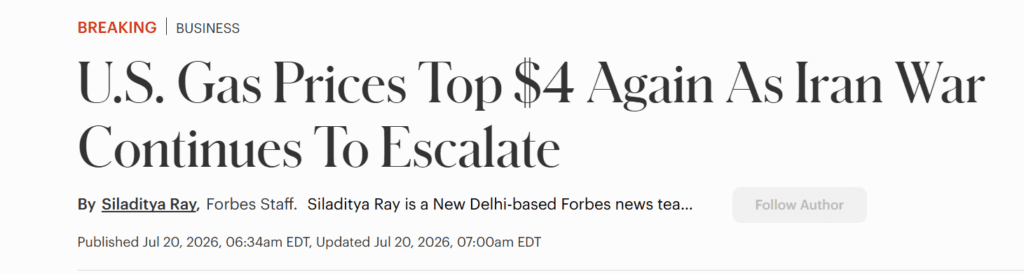
The national average gasoline price in the United States returned to around $4 per gallon.
The reason markets react so quickly is simple.
The Strait of Hormuz is not just another shipping lane.
It is one of the most important energy chokepoints in the world, carrying roughly a third of global oil shipments.
“Ding ding ding, we’re done trading for the day. Time to bomb Iran” https://t.co/CTHruFtjmL
— TT3 (@TradingThomas3) July 21, 2026
A prolonged disruption would hit far beyond gasoline.
Oil affects transportation.
Oil affects manufacturing.
Oil affects fertilizer production.
Oil affects food prices.
A regional military conflict can become a global inflation event when energy infrastructure becomes part of the battlefield.
The assumption throughout previous Middle East crises has been that diplomacy eventually creates an exit.
That assumption is becoming harder to defend.
The pattern now looks increasingly dangerous.
U.S. strikes lead to Iranian retaliation.
Iranian retaliation threatens shipping.
All maritime traffic banned in Strait of Hormuz, Iran says, as Israel readies to resume fighting https://t.co/wu3NNuAnl3
— CGTN (@CGTNOfficial) July 20, 2026
Shipping disruption pushes energy prices higher.
Higher energy prices spread through the global economy.
The cycle becomes harder to stop with every round.
This is why investors do not wait for a formal declaration of full-scale war.
Markets move when the probability of escalation changes.
🇺🇸BREAKING: One of four U.S. Strategic Petroleum Reserve sites was left inoperable as the reserve sits at a 43-year low during the Iran war.
180 million barrels were drained before the 2022 midterms and never fully refilled.
Equipment was "purchased and left on surface and… pic.twitter.com/U9pVd8nkKw
— Coin Bureau (@coinbureau) July 20, 2026
A sustained missile threat against U.S. naval assets near Hormuz could push oil far beyond current levels.
The $90 price level may only represent the market pricing the beginning of the risk.
The biggest danger is not only what happens between Washington and Tehran.
It is what happens if the world’s energy system becomes another battlefield.
The conflict has moved beyond a military exchange.
It is now testing whether the global economy can absorb another major supply shock.
Guardian on US attacks oil tanker in Strait – https://www.theguardian.com/world/2026/jul/16/us-attacks-oil-tanker-strait-of-hormuz-iran-tehran-strikes
CNN live on US strikes after ship attacks in Hormuz – https://www.cnn.com/2026/07/11/world/live-news/iran-war-trump
Forbes on gas prices top 4 dollars as war escalates – https://www.forbes.com/sites/siladityaray/2026/07/20/us-gas-prices-top-4-again-as-iran-war-continues-to-escalate/ (extra verification)
NPR on US launches strikes after ships hit – https://www.npr.org/2026/07/07/g-s1-132265/tanker-attack-strait-of-hormuz