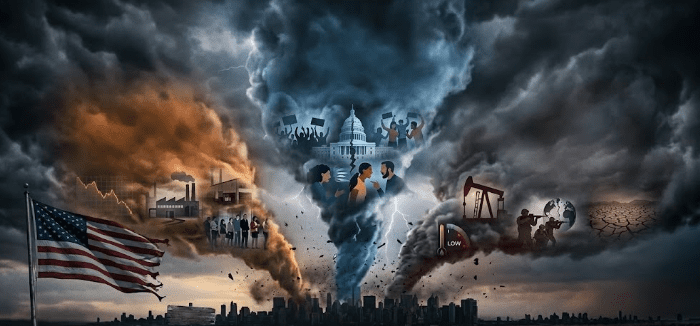
Oil has surged from $65 to $120 in just weeks. The Strait of Hormuz, which carries 20 percent of the world’s oil, remains effectively closed to most shipping. Initial predictions said flows could recover in 5 days. That stretched to 10 days, then 21 days, with only a slow recovery after that. Fertilizer prices are up 40 percent since the war began. Shipping costs are spiking. Industries from agriculture to transportation are absorbing these shocks and passing them to consumers.
Private credit markets are cracking under pressure. Funds holding trillions in corporate and real estate loans are halting withdrawals as investors panic. Bank of America warns that asset performance in 2026 is dangerously close to the patterns seen from mid-2007 to mid-2008. If private credit fails, the shock ripples through banks, corporations, and broader markets. Liquidity tightens. Borrowing becomes more expensive. Fear spreads.
The United States carries hidden obligations that dwarf official debt. Federal debt stands at $38 trillion, but when unfunded pensions, Medicare, Social Security, and other long-term commitments are included, total exposure nears $100 trillion. This keeps yields elevated and limits what the Fed and government can do without weakening the dollar. Every market correction now carries far greater costs.
These three forces are no longer separate. Energy shocks drive prices higher for consumers and businesses, feeding headline inflation. Credit stress freezes liquidity, forcing companies to delay spending and investment. Elevated yields make monetary and fiscal relief more expensive, effectively debasing the dollar and reducing purchasing power. The economy is caught in a compounding chain reaction. Rising oil, credit fragility, and hidden debt are converging to push inflation higher, weaken the dollar, and threaten to ripple through every corner of the U.S. economy.
This is not theory. It is happening now. Every gallon of gas, every loaf of bread, every dollar in savings is being squeezed. The Fed cannot act without making the dollar weaker. Wall Street cannot act without amplifying risk. The stage is set for a surge in inflation that could make 2022 look tame. Americans are about to pay the price for a perfect storm that has been quietly building for years.
Sources:
https://www.aol.com/articles/blackrock-fund-limits-withdrawals-redemptions-200405783.html
https://www.reuters.com/business/finance/private-credit-funds-slide-investors-sell-out-2026-03-12/
https://www.ft.com/content/22454850-a7da-4089-af17-a223fa11f31f
https://www.axios.com/2026/03/12/wall-street-private-credit-blackrock
https://www.businessinsider.com/private-credit-contagion-risk-mohamed-el-erian-ai-iran-war-2026-3
https://en.wikipedia.org/wiki/National_debt_of_the_United_States
The national debt isn't $39 trillion. One economist says it's actually $100 trillion
byu/fortune ineconomicCollapse