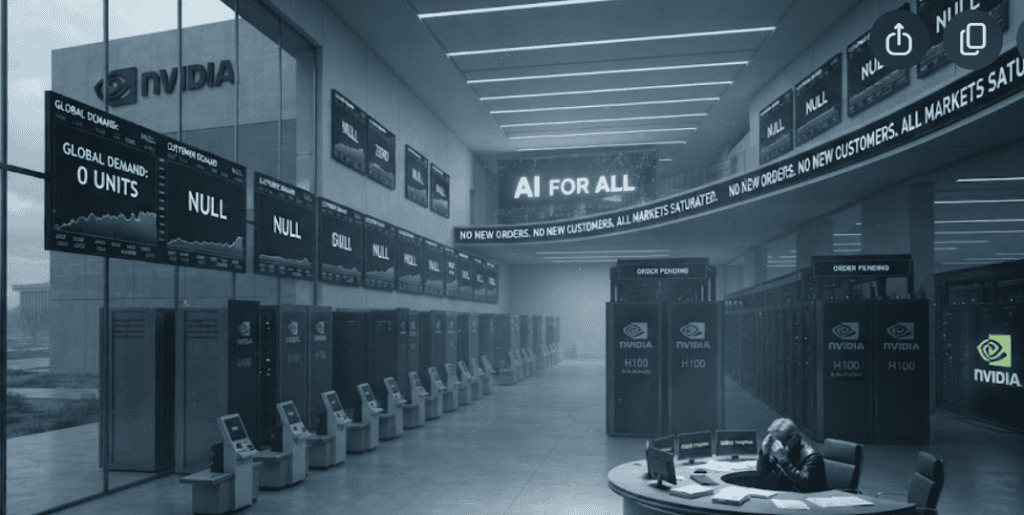
For years, the AI trade has been built around one simple assumption.
There will never be enough computing power.
Every new model requires more GPUs.
Every company wants more data centers.
Every hyperscaler needs more chips.
That assumption turned NVIDIA into one of the most important companies in the world.
But a question is starting to appear.
What happens when the problem is no longer getting enough chips, but finding enough reasons to keep buying them?
That is the uncomfortable argument emerging from the latest AI debates.
The first warning sign appeared when DeepSeek R1 arrived.
The market reaction was immediate.
Investors realized that a competitive large language model did not necessarily require the same amount of cutting-edge NVIDIA hardware that many assumed was unavoidable.
DeepSeek R1 was not the absolute best model in every category.
That was not the point.
The point was that the gap between performance and hardware requirements could be smaller than expected.
A wake-up call had arrived.
Then came more pressure from Chinese AI labs.
According to recent discussions around the sector, Kimi reached performance close to frontier models while using a mix of NVIDIA and Chinese chips.
Then Qwen 3.8 reportedly arrived with similar capabilities while being trained entirely on domestic Chinese hardware.
If these developments continue, they challenge one of the biggest assumptions behind the AI infrastructure boom.
That the world’s most advanced AI systems must always run on NVIDIA hardware.
The threat is not just China.
Inside the United States, almost every major technology company is working on alternatives.
Google has developed its own AI accelerators.
Amazon is building custom chips for cloud customers.
Microsoft has been developing its own AI silicon.
Meta has invested heavily in its own infrastructure.
The goal is simple.
Reduce dependence on the most expensive part of the AI stack.
NVIDIA’s advantage has always been more than just making powerful chips.
It built an ecosystem.
CUDA became a standard.
Developers learned the platform.
Companies built around it.
That created a powerful moat.
But every major customer spending hundreds of billions on AI infrastructure has the same incentive.
Find a way to spend less.
That brings up the second problem.
Demand.
The market has spent years focusing on whether NVIDIA can supply enough chips.
The next question may be whether customers still need unlimited amounts of them.
Data center construction is reaching a new bottleneck.
Not necessarily chips.
Power.
The biggest AI infrastructure projects require enormous electricity supplies.
Utilities cannot instantly build new generation.
Transmission lines take years.
Permits take years.
Local opposition is growing as communities deal with the consequences of massive data centers moving into residential areas.
The industry is discovering that announcing a data center is much easier than powering one.
A company can order thousands of GPUs.
But those GPUs are worthless if the facility cannot get enough electricity to operate at full capacity.
Then comes the hardest question.
Are AI companies themselves making enough money to justify the spending?
The AI race has created a massive infrastructure boom.
Companies rushed to secure NVIDIA’s “picks and shovels.”
Everyone wanted the hardware.
Everyone wanted capacity.
Everyone wanted to avoid being left behind.
But eventually investors have to ask whether the economics work.
How much revenue does each dollar of AI infrastructure spending generate?
How many customers will pay enough to cover the cost?
How long can companies continue spending at this pace if profitability does not catch up?
The first phase of AI was about building.
The next phase is about proving returns.
That transition matters.
A company can justify almost unlimited spending when everyone believes demand will be infinite.
The problem begins when investors start asking where the next wave of demand comes from.
NVIDIA does not need to lose its technology advantage to face pressure.
It only needs growth expectations to become harder to meet.
The stock market is not pricing NVIDIA based only on what it is today.
It is pricing in years of continued explosive AI infrastructure spending.
That means even a slowdown can create problems.
Not because AI disappears.
Not because NVIDIA stops being important.
But because markets punish companies when reality falls short of extraordinary expectations.
The biggest risk for NVIDIA may not be a better chip.
It may be fewer customers willing to keep buying them at the same pace.
The AI boom has spent years asking one question:
“How many GPUs can we get?”
The next phase may ask a much harder one:
“Who still needs all of them?”
$ORCL 5 year CDS back to new highs 💀 pic.twitter.com/fTx5iQvLiU
— QE Infinity (@StealthQE4) July 20, 2026