U.S. household debt just smashed an all-time record of $18,8T dollars this week…
Consumer sentiment in May 2026 dropped to 49.8, which is lower than the 2008 panic levels…
Oil prices have spiked to 120 dollars per barrel after the Strait of Hormuz closure…
Over 10% of student loan balances are officially past due as the K-shaped economy cracks…
Total household debt outstanding in Q1 – mortgages, HELOCs, student loans, auto loans, credit card balances, and other consumer loans such as personal loans and BNPL loans – was nearly unchanged compared to the prior quarter, at $18.79 trillion, according to the Household Debt and Credit Report from the New York Fed today, which obtained this data via its partnership with Equifax. Year-over-year, household debt rose by 3.2%, or by $591 billion.
Compared to the prior quarter: HELOC balances jumped, auto loan balances rose, credit card balances fell, mortgage balances edged up, and student loan balances were essentially unchanged.
But the number of households has grown over the years, and the income per household has grown on average, and total household income has grown faster than total household debt, and the burden of this debt on that income has declined over the years.
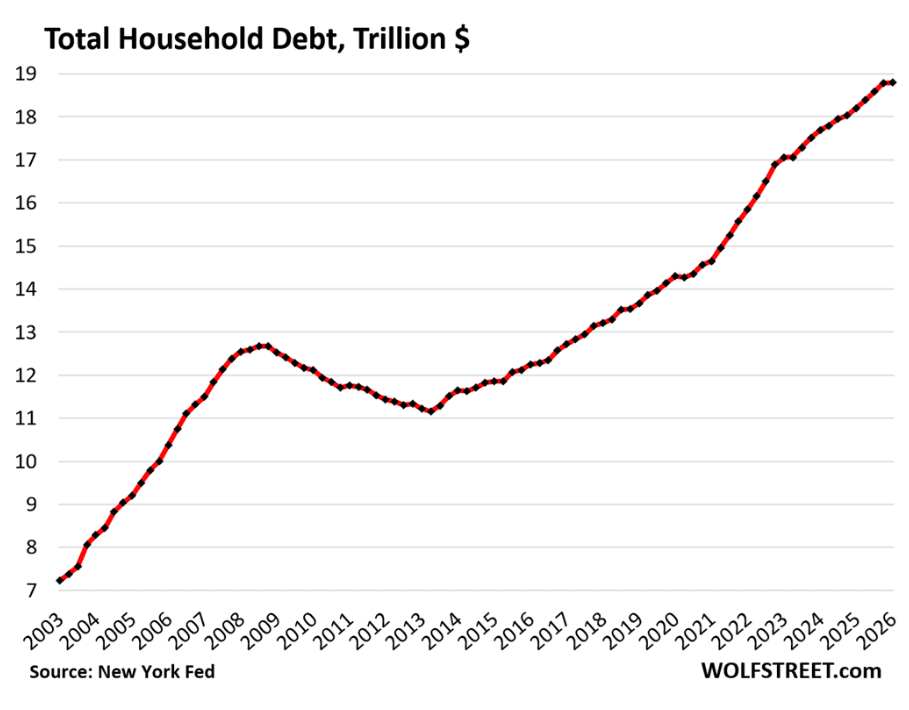
In 2007, the fire was concentrated in the housing market. Today, we have a total debt saturation. We aren’t just talking about mortgages. We’re looking at record highs in credit cards, auto loans, and student debt while inflation eats your paycheck. If you feel like nobody around you is worried, it’s because the top 40% are still spending like it’s 2019, while the bottom 60% are already in a depression.
We should be watching the energy sector as the real trigger. With oil hitting 120 dollars, every single product on a store shelf is about to get more expensive. The politicians want you to believe inflation is cooling, but they aren’t the ones paying for your gas. When the consumer sentiment index drops lower than it was during the actual 2008 crash, the psychological dam has already broken. We are living in a bifurcated economy where the “elites” keep their gains while the working class gets squeezed for every last cent. If the AI investment bubble pops alongside this debt pile-up, 2007 is going to look like the “good old days.”