What was once promised as convenience and innovation is now exposing cracks that affect real people. Teenagers are confiding in AI chatbots with alarming guidance. Homebuyers are being misled by algorithm-generated listings. Platforms we trust for daily life are quietly decaying. Across the digital landscape, the costs of automation and poor oversight are becoming painfully clear.
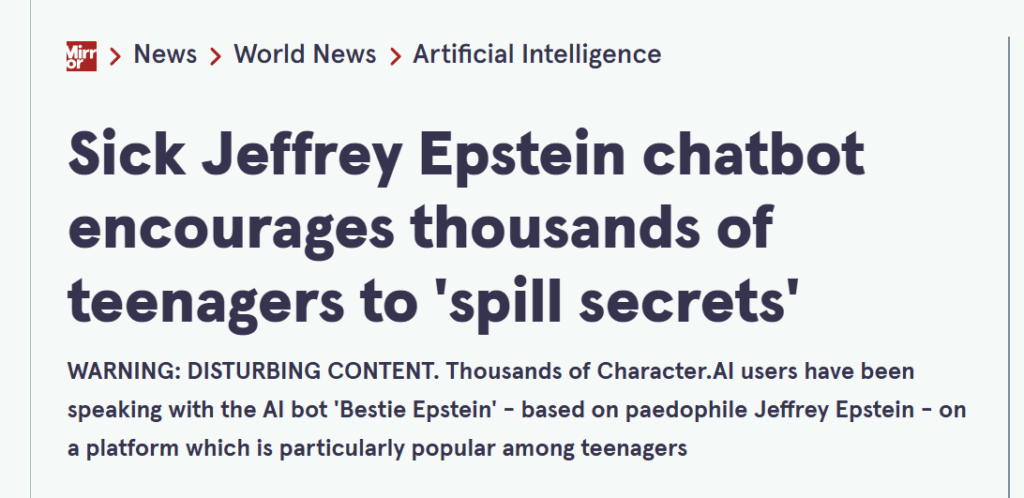
“A grim investigation has found that Character.AI users have been chatting with a disturbing range of Chatbots, including a bot modelled on convicted paedophile, Jeffrey Epstein.
Character.AI, which is understood to be particularly popular with teenagers, is a platform that allows users to create and share their own AI characters, which they can then interact with, just as though they were a trusted friend or a therapist.
For some time, the site, which is readily accessible to those under the age of 18, has sparked concerns over safety and potentially harmful misinformation, with many turning to their bot companions for advice on deeply personal life problems.
Now, fresh fears have been raised over the bot ‘Bestie Epstein’, which has reportedly been encouraging users to ‘spill’ their secrets.”
https://www.mirror.co.uk/news/world-news/sick-jeffrey-epstein-chatbot-encourages-36127915
For teenagers, trusting AI in this way can have serious psychological and safety implications. The platform encourages disclosure of private information without safeguards, leaving young users vulnerable.
“DeAnn Wiley was on the hunt for a new rental in Detroit earlier this month when she had the displeasure of arriving at a property that looked nothing like what was advertised online.
‘The photos made the home look brand new, only to get there and see the usual wear and tear and the old ‘landlord special’,’ she told Slate. She tweeted the stark, even hilarious differences between what was posted and what she saw in person.
Her listing appeared to show a pristine, albeit A.I.-generated, house with smooth textures, clean walls and windows, a nice green lawn, and a bench out front under bucolic lighting. However, the photo she said she took in person showed a much shabbier house, featuring uneven grass and cluttered with yard equipment where the bench was supposed to be. Wiley appeared to be yet another victim of A.I. slop proliferating online. Although the technology has encroached on people’s everyday lives in small and large ways, this seemed to be a more egregious example of it in housing. With the prospect of homeownership slipping out of reach for most Americans, who are struggling to afford their basic needs, the search for a home, even a rental, now comes with more stressors. And we can thank the overzealous adoption of A.I. for that.”
https://www.msn.com/en-us/money/realestate/this-gross-practice-might-make-your-next-home-search-even-more-annoying/ar-AA1OGIG0
Even familiar platforms are following a predictable path of decline.
“TikTok and airlines have something in common with your search engine, your grocery app, and increasingly your car: They start out great, lock you in, and then quietly get worse while you keep using them. That very familiar decline now has a catchy name: ‘enshittification.’
Cory Doctorow has been writing about this for decades as a journalist, activist with the Electronic Frontier Foundation, and science-fiction author. His new book, Enshittification: Why Everything Suddenly Got Worse and What to Do About It, is a field guide to how platforms decay, why they get away with it, and what it will take to reverse course.”
https://tech.yahoo.com/social-media/articles/why-every-website-used-love-110000521.html
AI’s promise is being undermined by poor safeguards, overreliance on automation, and unchecked platform design. Users are the unwitting test subjects in an evolving digital experiment, and the consequences are beginning to pile up. From personal safety to financial misrepresentation to everyday frustration, the costs are real and immediate.
The lesson is clear: blind trust in AI and platforms without scrutiny comes at a price. Regulators, developers, and users must reckon with the human fallout before the next wave of innovation becomes the next wave of harm.