The number that jumps out is 1.2 million margin calls in one crash.
South Korea’s retail trading boom just hit the ugly part of the cycle.
The KOSPI dropped 8.95% in one day, triggering a circuit breaker.
SK Hynix fell 15.37%.
Samsung dropped 10.7%.
And the damage was not just on paper.
Around 320,000 to 360,000 accounts were fully liquidated by brokers.
Positions gone.
Some investors left owing money.
🚨 1.2 million Koreans just got margin called in a single crash.
That is roughly 1 in every 30 working age adults in the entire country.
Korea's Financial Supervisory Service says over 1.2 million leveraged retail accounts triggered margin calls as of July 13.
Between 320,000… pic.twitter.com/Urr7M1wbJ1
— Bull Theory (@BullTheoryio) July 14, 2026
The reason the selling got so violent comes down to leverage.
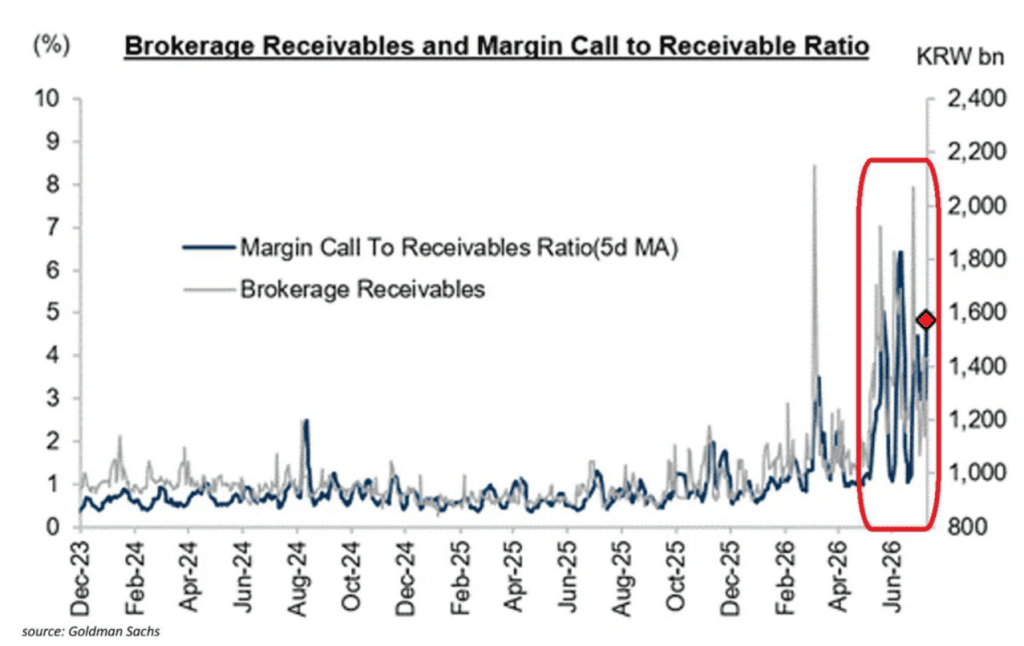
The margin call to receivables ratio jumped to around 5%, compared with the usual 1% to 2% range over the past two years.
Brokerage receivables tied to margin loans crossed 2 trillion KRW, nearly double the typical 900 billion to 1 trillion KRW range.
Retail traders had piled into leveraged ETFs and crowded into the same chip names.
Then the selling started.
And forced selling does not care about price targets or long-term stories.
A broker does not wait for a stock to recover.
A margin call gets triggered.
The position gets sold.
That selling pushes prices lower.
Which triggers more selling.
The worst part is the final damage may not even be fully visible yet.
Liquidation data often arrives after the market move.
So the numbers from this crash could still grow.
The warning signs were already there.
Korean retail margin debt surged 72.5% in 2025 as investors chased semiconductor stocks.
Now the same leverage that helped push stocks higher is accelerating the fall.
A market can survive bad news.
It struggles when everyone is forced to sell at the same time.