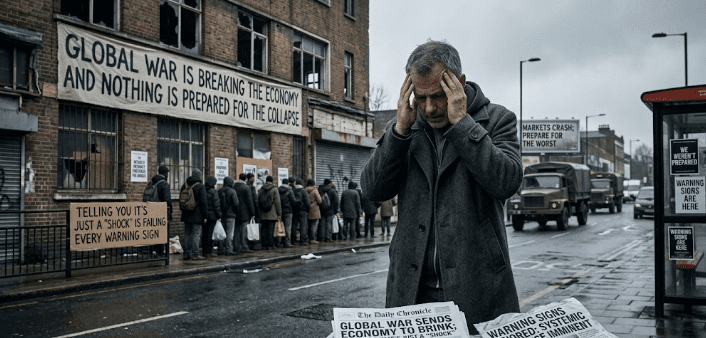
This morning’s developments are worse than most people realize. Iran is not just sitting back after initial strikes. Its military has openly declared that any ship tied to the United States, Israel or their allies passing through the Strait of Hormuz could be targeted, a move that effectively turns what used to be the world’s busiest oil transit route into a war zone. That is not abstract danger. That is direct action against global commerce and energy supplies.
Today’s frontline shock is the attack on multiple cargo vessels in Hormuz where at least three ships were struck by projectiles, including a Thai bulk carrier that caught fire and forced its crew to abandon ship. That strait once carried roughly 20 percent of the world’s oil, and now it is being hit over and over again.
The International Energy Agency has just agreed to release 400 million barrels from emergency reserves, the largest coordinated release in its history, because oil markets are reacting like a system that is breaking. That release is about a third of the total stockpiles member nations keep for emergencies, and it is still not calming traders who see a chokepoint that is barely functioning.
This is not the only shock today. The New York Times reported that President Trump and his top advisers miscalculated how Iran would respond to U.S. and Israeli strikes, dismissing warnings that closing shipping lanes carrying a massive share of global oil would trigger economic catastrophe. That blunder is now visible in the spike in freight costs, insurance premiums and energy volatility that ordinary people will soon feel in every corner of life.
And there are direct homeland threats emerging too. The FBI has warned police departments in California that Iran allegedly aspired to launch surprise drone attacks off the U.S. West Coast using unmanned aerial vehicles from an unidentified vessel in international waters. There is no timing, no confirmed target, but the warning was serious enough that multiple agencies received it and are now on alert.
Most people still think that a war so far away could not affect their daily life. They are wrong. Every attack on a ship, every barrel withheld from world markets, every warning to California police, every frantic emergency decision by 32 oil producing nations adds up to one stark truth: the interconnected systems that delivered prosperity, cheap energy and economic stability are under siege simultaneously.
The collapse is not a distant threat. Economists, policymakers and ordinary people are beginning to see it in rising costs, in markets that cannot settle, in shipping lines that refuse to enter one of the world’s most vital channels. And nowhere in these developments is there a simple exit or a quick return to normalcy.