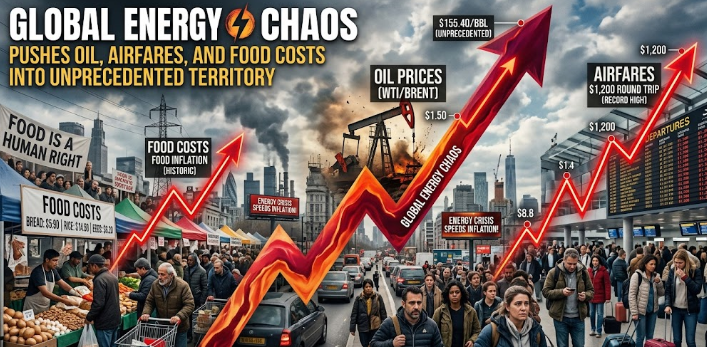
The Trump administration has now temporarily allowed Russian oil already at sea to be sold, freeing roughly 100–128 million barrels into the market. Oil had surged past $100 per barrel in the past week because of disruptions from the Iran war, blocked shipping through the Strait of Hormuz, and attacks on tankers. The move may stabilize some supply, but it also channels revenue directly to Moscow while sanctions were supposed to block it.
Meanwhile, the Strait of Hormuz, which handles 20% of global oil, is effectively paralyzed. Tankers are stuck or rerouted. Ports are under threat. Attacks on vessels have made the passage extremely dangerous, forcing shipping companies to reroute or delay shipments.
Airlines are already passing the costs to passengers in staggering ways. Jet fuel prices have climbed more than 60% in the last month, and carriers are imposing new fuel surcharges of $50–$150 per ticket on international flights. Domestic airfares are rising sharply, some routes doubling in price in a matter of days. U.S. carriers could face $24 billion in additional fuel costs alone, which translates directly to your next flight, your package delivery, and every travel-dependent service.
Analysts warn this is not a temporary spike. There are five structural reasons energy costs may remain high for years:
Supply shock — Millions of barrels per day are missing from the market because of war and blocked shipping lanes.
Transportation costs surge — Diesel and jet fuel jumps hit trucking, shipping, airlines, and farming simultaneously.
Airline fuel shock — U.S. carriers alone face $24 billion in extra costs, forcing fare increases immediately.
Supply chain disruption — Shipping reroutes and airspace closures delay cargo globally, pushing freight prices higher.
Long-term inflation pressure — Oil prices may not return to pre-crisis levels until 2027, creating stagflation across the global economy.
Even food and consumer goods are under threat. Higher fuel and shipping costs combine with fertilizer disruptions to create price spikes that could hit your grocery bills in 30–60 days.
Putin is positioning Russia to benefit from the chaos, while the Gulf conflict ensures that every move in the region ripples through your wallet. Oil, food, airfare, and shipping costs are no longer isolated—they are interconnected shocks happening simultaneously.
This is not just a geopolitical story. This is an economic crisis unfolding in real time, and the new normal may be far worse than anything the markets or the public are prepared for.