Congress passed 133 broadband programs. Its Big Idea Is a 134th.
There are things that a free market will never do, and it’s usually for very good reasons.
Running fiber-optic cable down a twelve-mile dirt road costs a fortune, and the handful of households scattered along that road will never pay enough in monthly bills to justify the cost of laying the cable.
That’s why private companies don’t bother laying fiber in rural areas: the math doesn’t work.
But living out in the country is a choice— one that plenty of people gladly make. Some people value the space, the quiet, and the empty horizon far more than same-day Amazon delivery or 1 gigabit Internet.
And most people typically know about these trade-offs before they move out to the country. Urban and suburban conveniences are just that— conveniences. They are not inalienable “rights”. No one is entitled to fast internet.
Yet Congress has decided at least 133 times that fast Internet, is, in fact, a right. And one that they have decided to provide with your money.
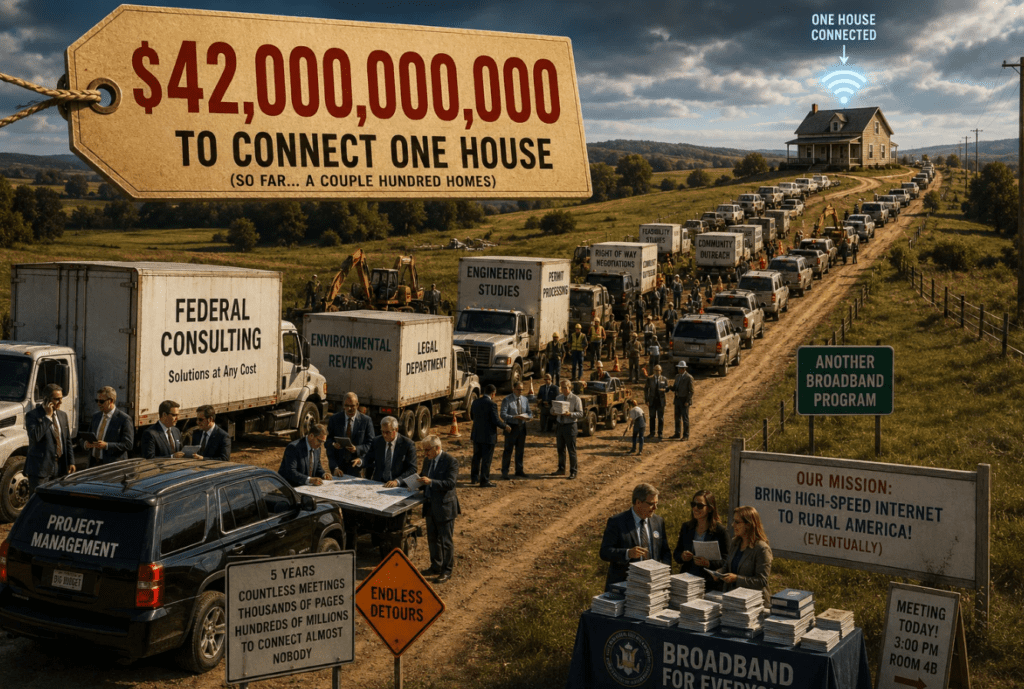
Its biggest program is the Broadband Equity, Access, and Deployment program, known as BEAD. It was created in 2021 as part of Joe Biden’s staggering infrastructure bill, and over $42 billion was allocated to wire up rural America.
Five years later it has connected almost nobody. The first BEAD-funded household in the entire country came online only this spring— a single home near Ogallala, Nebraska, hooked up in May 2026. About a hundred more followed in rural Louisiana. That was the triumphant achievement of five years and ridiculous money spent: a couple hundred connected homes.
BEAD is far from alone. In 2023, the Government Accountability Office— Congress’s own watchdog— set out to count the federal government’s broadband programs and found more than 133 of them, scattered across 15 separate agencies.
These programs are largely similar yet have no coordinated plan to prevent overlap, or wiring the same stretch of dirt twice.
The GAO told them to sort it out. When it checked back in 2025, most of the work hadn’t been touched.
So what do you do about 133 overlapping programs and a flagship that spent billions to connect a couple hundred homes?
If you’re the United States Congress, you add a 134th broadband program!
On June 3, the House Rules Committee advanced next year’s Agriculture spending bill with fresh loans and grants for the US Department of Agriculture’s ReConnect program— the 134th rural broadband fund, stacked on the $42 billion one that barely works and the 133 others nobody can keep track of.
A private company that spends so much money to connect a couple hundred homes would be bankrupt, and its executives likely facing criminal charges. A federal agency that does it gets a sequel.
What makes it worse is that the problem was already solved by the free market.
Anyone at the end of a dirt road can order a Starlink dish online and have high-speed internet running within about a week— no federal fiber, no years-long wait, no act of Congress.
For that $42 billion price tag, the US taxpayer could have bought a Starlink dish for every one of the top-end estimate of 12 million unserved households in America AND prepaid their internet service for the next five years.
So where did that money go?
It is egregious. The government borrows $2 trillion a year to do this sort of garbage, and acts like a single dollar cut from the budget would throw single mothers out on the streets. They literally wail that “people will die”.
And half the country thinks the answer is to collect more in taxes!
Keep in mind, this $42 billion is part of the legitimate spending — not the $600 billion a year the Treasury Secretary estimates is lost to outright fraud, the $186 billion in improper payments the government admits to, or the hundreds of billions in legal graft on top.
All that borrowing and waste gets paid for one way or another— a weaker dollar, higher taxes, more inflation.
You can’t change any of that. But just like those people without internet on a dead-end road, you do have a choice.
That choice is a Plan B.
The tools to route around Congress already exist.
Owning real assets— gold, silver, energy, productive technology, and the well-managed businesses that produce them— protects your purchasing power when the government reaches for the printing press.
Moving some savings into stronger jurisdictions, establishing a second residency, and taking every legal step to cut your tax bill all mean that no single government’s incompetence has total claim over your life.
None of it requires predicting the next crisis. It benefits you, and gives you options, no matter what happens next.