Surging inflation drove many consumers to cheaper brands or lower-quality products, but new data suggests that switching might not have saved them as much as they might have expected.
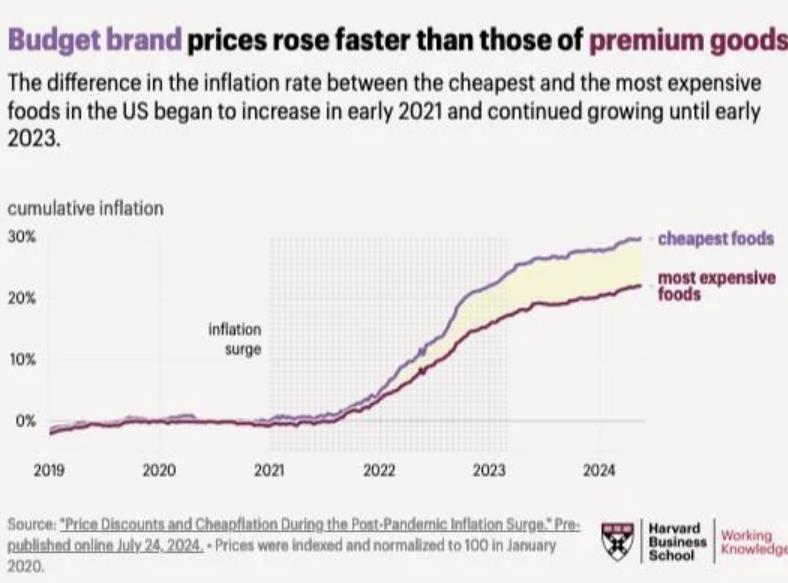
During the most recent period of high inflation, prices of the least expensive products increased more than those of the costliest, according to an analysis of microdata from large retailers by Harvard Business School Professor Alberto Cavallo. In a forthcoming article in the Journal of Monetary Economics, Cavallo and coauthor Oleksiy Kryvtsov, senior research officer at the Bank of Canada, refer to this phenomenon as “cheapflation.”
In the United States, the prices of the cheapest food products climbed 30 percent between January 2020 and May 2024, outpacing the 22 percent increase of the fanciest foods.
https://hbswk.hbs.edu/item/charting-cheapflation-how-budget-brands-got-so-pricey
h/t Perfect_Alarm_2141