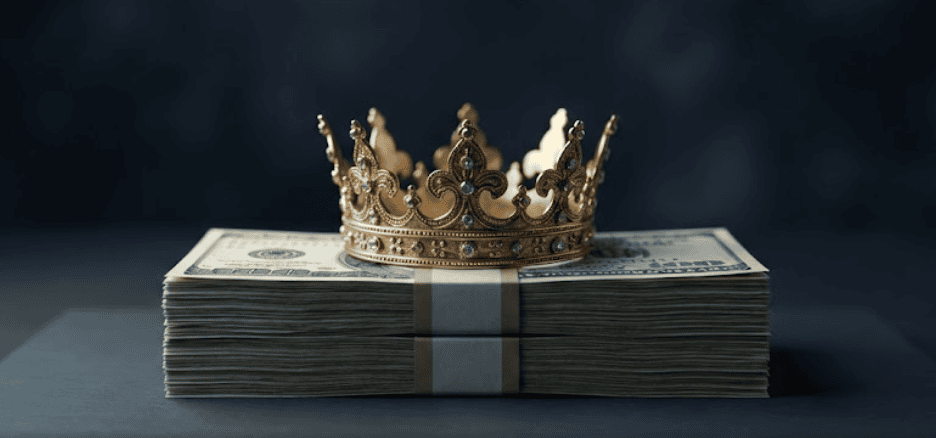
Every bull market eventually reaches the same point.
Cash becomes a joke.
Social media fills with “buy the dip.”
Every pullback is another opportunity.
Holding cash is treated like admitting defeat.
Which makes one question hard to ignore.
If cash is such a terrible investment, why is Berkshire Hathaway holding roughly $397 billion in cash, Treasury bills, and cash equivalents?
That’s roughly 59% of Berkshire’s investable assets.
It’s also close to 1% of the entire U.S. economy sitting in liquid assets.
People immediately jump to one conclusion.
“Warren Buffett must think the market is going to crash.”
Maybe.
But I think that’s the wrong question.
The better question is this.
When does cash suddenly become the most valuable asset in the world?
Not during a bull market.
Not when stocks are making new highs.
Not when everyone believes AI spending will keep growing forever.
Cash only becomes king when the world suddenly runs short of liquidity.
That’s the part many investors forget.
A stock market crash doesn’t begin because investors wake up and decide companies are worthless.
It begins because someone needs cash.
A hedge fund gets a margin call.
A bank tightens lending.
Credit markets freeze.
Borrowers can’t roll over debt.
One forced seller becomes a thousand.
Then something strange happens.
Investors stop asking what an asset is worth.
They ask one question.
Who still has cash?
We’ve seen this before.
During the dot-com bubble, Buffett was mocked for refusing to chase internet stocks. He was called old-fashioned and out of touch while everyone else believed technology stocks could only go higher.
Then the bubble burst.
During the 2008 financial crisis, investors sold almost everything they could to raise dollars.
Real estate collapsed.
Stocks collapsed.
Commodities collapsed.
Even good businesses traded at distressed prices because buyers disappeared.
The same thing briefly happened in March 2020.
Gold sold off.
Treasuries came under pressure.
Investors weren’t selling because they hated those assets.
They were selling because they needed dollars immediately.
The Federal Reserve eventually stepped in with extraordinary liquidity programs, but for a brief period the entire financial system reminded everyone of one simple truth.
Cash isn’t exciting.
Cash is optionality.
That’s why Berkshire’s balance sheet deserves more attention than Buffett’s interviews.
Professional investors rarely communicate with speeches.
They communicate with allocations.
Today, Berkshire is choosing to hold nearly $397 billion in liquid assets instead of deploying that money into a market many believe still has years of upside ahead.
That doesn’t automatically mean Buffett expects a crash tomorrow.
It does suggest he believes opportunities today are less attractive than keeping an enormous amount of dry powder available.
That’s a very different message.
There’s another reason this matters.
Markets today are increasingly built on leverage.
Borrowed money amplifies gains on the way up.
It also amplifies losses on the way down.
We’ve already seen what that looks like in South Korea, where about 1.2 million people—roughly 3.4% of the adult population—received margin calls after AI-related stocks tumbled. Forced selling created more selling, which created even more forced selling.
The United States isn’t South Korea.
But the mechanism is universal.
Liquidity crises don’t care whether you’re bullish or bearish.
They don’t care whether your company has great earnings.
They don’t care how many analysts still have “buy” ratings.
When leverage starts unwinding, markets become sellers first and analysts second.
That’s when cash stops looking lazy.
It starts looking priceless.
Maybe AI spending keeps booming.
Maybe stocks continue climbing for years.
Maybe Berkshire underperforms while everyone else celebrates another bull market.
That’s possible.
But history suggests something else.
The investors who make the biggest fortunes after every major crisis usually have one thing in common.
They aren’t the smartest.
They aren’t the fastest.
They’re simply the ones who still have liquidity after everyone else has run out.
Cash looks like the worst investment in the world…
Right up until it’s suddenly the best one.