Something changed in this story.
For years, anyone who seriously discussed a possible lab leak was often treated like they were chasing a conspiracy. Now the picture looks much more complicated.
The latest declassified material shows something uncomfortable: the US government was funding coronavirus research connected to the Wuhan Institute of Virology through programs involving NIAID and EcoHealth Alliance. Reports mention roughly $600,000 sent toward research connected to bat coronaviruses, with some work involving questions around gain of function.
That does not prove someone created a bioweapon. It does not prove a deliberate release. Those are massive claims that still have not been proven.
But it does raise a much simpler question:
Why were people so certain there was nothing to investigate?
The intelligence community was never actually unified. The FBI assessed a lab incident with moderate confidence. The Department of Energy leaned lab leak with low confidence. The CIA later moved toward a lab origin with low confidence. Other agencies remained uncertain or favored natural origin.
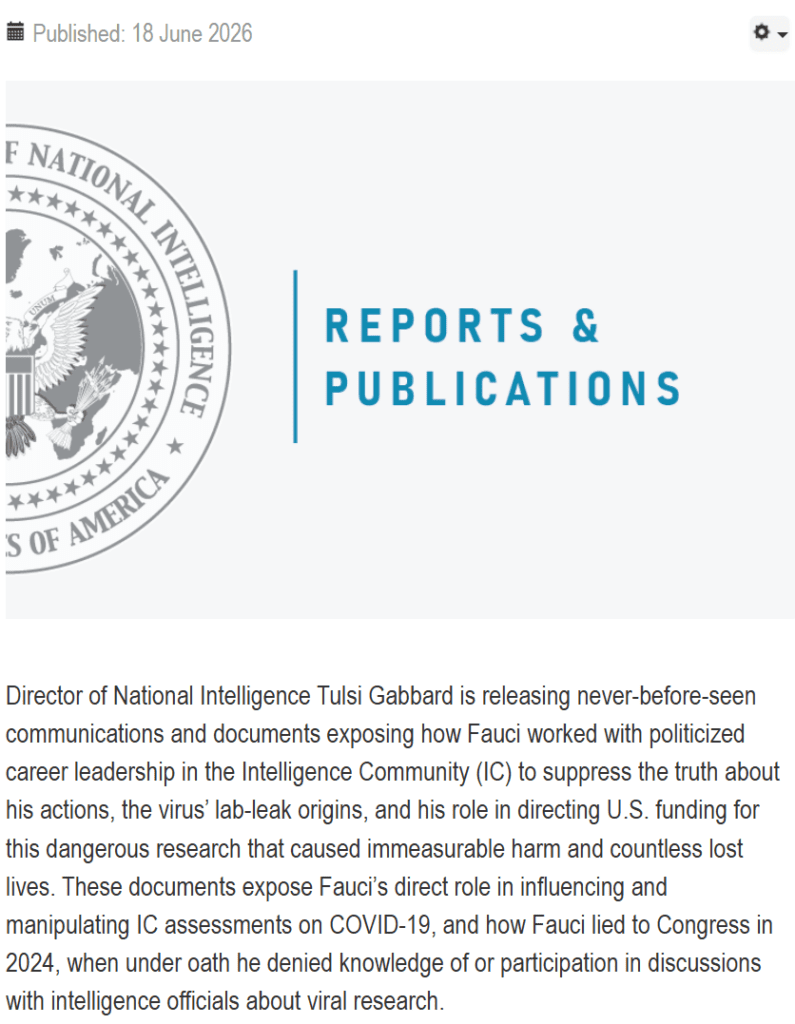
ODNI Gabbard declass announcement + docs
Declass PDF part 1 example
Older IC origins assessment
The funny part is that the public debate was treated like there was a clear answer when behind the scenes the agencies were literally disagreeing.
Then there is the “Proximal Origin” paper from March 2020.
That paper became one of the biggest arguments used against the lab leak theory. But later emails showed scientists had private concerns about possible engineering before publishing a paper that strongly argued for natural origin. Critics say the process helped shut down discussion too early. Defenders say it was normal scientific debate under pressure.
The bigger issue might not even be the exact origin.
It is the pattern.
Risky research happened. US money was involved. Chinese military connections appeared in released documents. Officials were worried about public messaging. The debate became political before the evidence was fully understood.
That does not automatically mean there was a criminal conspiracy.
A lot of people jump from “there was a possible lab incident and officials downplayed concerns” straight to “there was an intentional attack.”
Those are completely different claims.
The more realistic concern is probably less dramatic but still serious:
Did institutions protect reputations and programs before protecting public trust?
Because the pandemic happened. Millions died. Governments made mistakes. Scientists made mistakes. Politicians used the issue for their own fights.
The biggest question now is not whether every extreme accusation was true.
It is whether the public was given the full picture when it mattered most.
And if more documents keep coming out, people will probably pay less attention to the arguments and more attention to one thing:
Who knew what, and when did they know it?