The technology is real.
That is what makes this so interesting.
The biggest risk to the AI boom is not that AI fails.
It is that the economics fail.
Look at what is happening.
Microsoft invested roughly $13 billion into OpenAI.
OpenAI then spent billions on Azure.
Microsoft booked the revenue.
Google committed tens of billions to Anthropic.
Anthropic spends heavily on Google Cloud and chips.
Google books the revenue.
Wall Street sees massive AI growth.
But how much of that growth is coming from end customers and how much is money moving around inside the AI ecosystem?
That is a question investors are eventually going to ask.
Then there is the cost problem.
One company, Workato, saw its Anthropic bill jump 700% overnight after Anthropic switched from a flat subscription model to token-based pricing.
ANTHROPIC CEO: WITHOUT HUNDREDS OF BILLIONS IN REVENUE, AI COMPANIES COULD FACE EXISTENTIAL RISK
— First Squawk (@FirstSquawk) June 20, 2026
Its own CIO said AI companies had been subsidizing usage for years and that customers are only now seeing the real costs.
And suddenly some of the biggest AI believers are hitting the brakes.
Uber reportedly burned through its entire 2026 AI budget by April and now caps employee usage.
Amazon told employees to stop using AI simply for the sake of using AI.
Meta, Walmart, Cisco, and others have reportedly introduced limits and controls on AI spending.
JPMorgan even circulated an internal note warning that AI bills were getting out of control.
That is not the behavior you expect during an economic revolution that is effortlessly paying for itself.
Then there is what Bill Gates said.
Bill Gates remains one of the strongest believers in AI.
Yet even he thinks some of today’s biggest spenders are going to regret the money they are throwing at the sector.
Bill Gates thinks some of the companies spending the most on AI are going to regret it (Save this).
His argument is that the current investment frenzy is going to produce a wide range of outcomes:
1. Some companies will be glad they spent every dollar.
2. Some will will have… pic.twitter.com/2x1U7tFw9a
— Milk Road Macro (@MilkRoadMacro) June 20, 2026
His argument is simple.
Some companies will be thrilled they invested every dollar.
Others will end up with data centers whose electricity costs never make economic sense.
Others bought massive amounts of chips before proving they could earn a return on them.
The constraint he keeps coming back to is power.
Not intelligence.
Not software.
Power.
The AI race is becoming an electricity race.
And someone is going to be left holding very expensive infrastructure.
Now look at the companies preparing to sell this story to public investors.
OpenAI and Anthropic are reportedly pursuing IPOs at valuations approaching $850 billion or more.
Neither company is profitable.
OpenAI reportedly lost $5.09 billion in 2024.
In 2025 that loss reportedly exploded to $38.5 billion.
Nearly eight times higher in a single year.
The problem is that costs appear to be rising faster than revenue.
At the exact moment Wall Street is being asked to believe the opposite.
Meanwhile competition is getting cheaper.
According to benchmarking from Artificial Analysis, Anthropic’s flagship model cost about $4,811 to complete a standardized test suite.
OpenAI cost about $3,357.
China’s DeepSeek completed the same benchmark for roughly $1,071.
Kimi reportedly came in around $948.
That matters.
Because OpenAI is already considering price cuts to defend market share.
Price wars are great for customers.
They are not great for companies losing billions.
And then there is the stock market.
Twenty stocks in the S&P 500 have doubled this year.
Nineteen are AI-related.
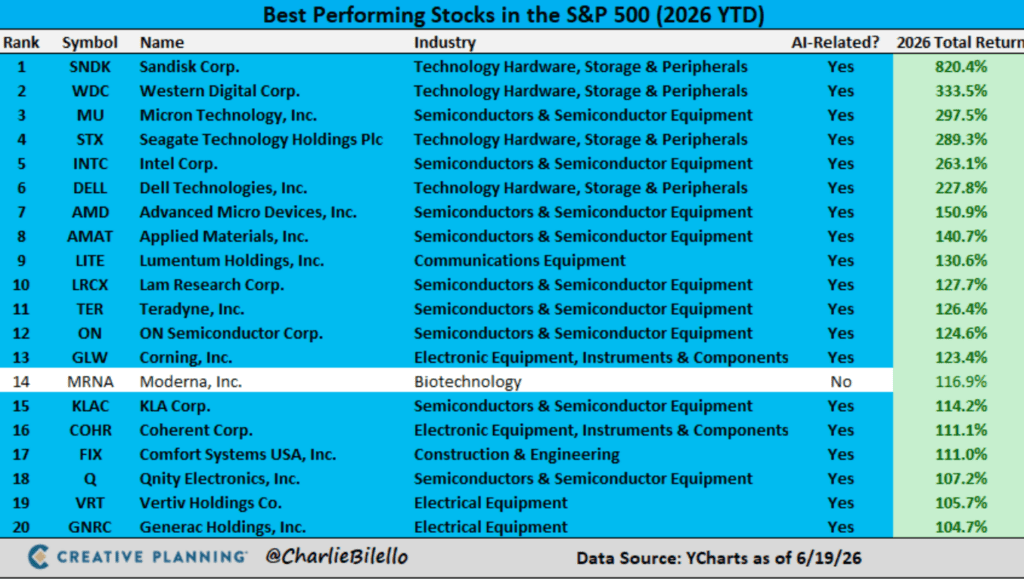
That is the kind of narrow leadership often seen during speculative manias.
The semiconductor index is flashing similar signals.
The monthly RSI on the SOX recently reached 89.
The last comparable readings occurred in 1995 and 2000.
One was followed by a 54% decline.
The other was followed by an 84% collapse.
History does not repeat perfectly.
But it rhymes often enough that investors should pay attention.
The AI revolution is real.
The question is whether the profits will ever justify the spending.
Right now hundreds of billions of dollars are being poured into chips, data centers, cloud infrastructure, and power generation on the assumption that future demand will make it all worthwhile.
If that assumption turns out to be wrong, the technology will survive.
The economics will not.
What happens when we overlay the Dot-Com bubble of 2000 directly over the AI bubble of 2026?🤔
The visual is all one needs. The eerie similarity in time frame, structure, and character reveals everything. Nothing ever changes … the same speculative cycle, the same crowd… https://t.co/04M2aPoSEB pic.twitter.com/wWOXth0O6b
— The Great Martis (@great_martis) June 20, 2026