This is starting to feel familiar.
US tech companies have now committed a record $850 billion in future data center leases for AI, up 204 percent from a year ago.
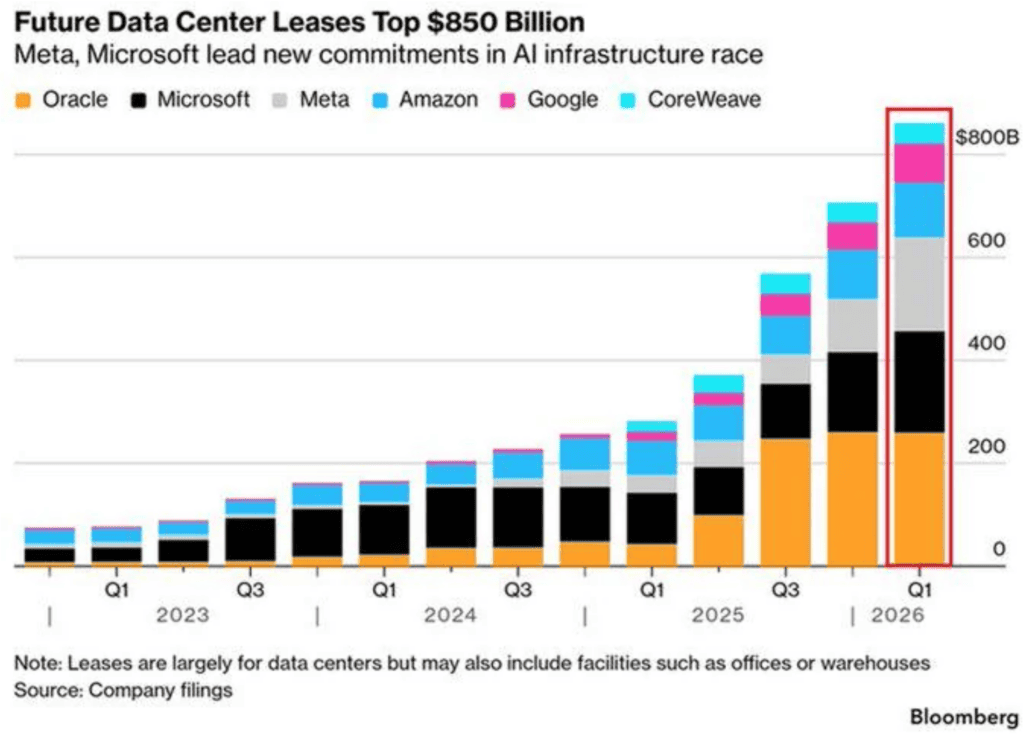
Oracle alone accounts for about $250 billion. Meta added $79 billion. Microsoft added $41 billion.
That is an enormous amount of money being committed before anyone knows what the long term return will be.
The market is starting to notice.
Oracle stock has dropped about 40 percent in a month while investors question whether massive AI spending is destroying free cash flow faster than it creates new profits.
Oracle $ORCL has cut their market cap down by 40% in a month… why?? pic.twitter.com/wJi5IGwD9Q
— Just a Dude Who Invests (@DudeWhoInvests) July 5, 2026
Then another wrinkle shows up.
Researchers in China unveiled a neuromorphic chip that reportedly outperformed Nvidia’s A100 by up to 478 times on one specific brain reconstruction task using a completely different architecture.
🚨 CHINA JUST BUILT A CHIP THAT OUTPERFORMS NVIDIA BY UP TO 478 TIMES ON SPECIFIC AI TASKS.
Researchers from Peking University developed a neuromorphic chip that can reconstruct complex brain surfaces in under half a second.
The key difference from a standard GPU is… pic.twitter.com/vSQrVSyprA
— Bull Theory (@BullTheoryio) July 5, 2026
It is only one workload, not a replacement for GPUs, but it is another reminder that spending the most money does not always produce the best technology.
This reminds me of the internet buildout around 2000.
The internet changed the world.
The problem was not the technology. The problem was investors trying to price in decades of future growth all at once.
Fiber got laid everywhere. Billions were spent. Then the bubble burst because the profits took much longer to arrive.
AI probably changes the world too.
The question is whether Wall Street has already paid tomorrow’s price for today’s earnings.
That is usually how bubbles end. Not because the technology fails, but because expectations get there long before the cash flows do.