Weak yen boosts exporters but squeezes importers and smaller firms hit hard.
Japan's central bank balance sheet is falling at the quickest pace in history as they attempt to stop the the rapid devaluation of the Japanese Yen. So far it has been ineffective at keeping the Japanese Yen above 160:1 USD and they appear to be losing control of their yield curve on Treasuries.
byu/Boo_Randy_Revival inWallstreetsilver
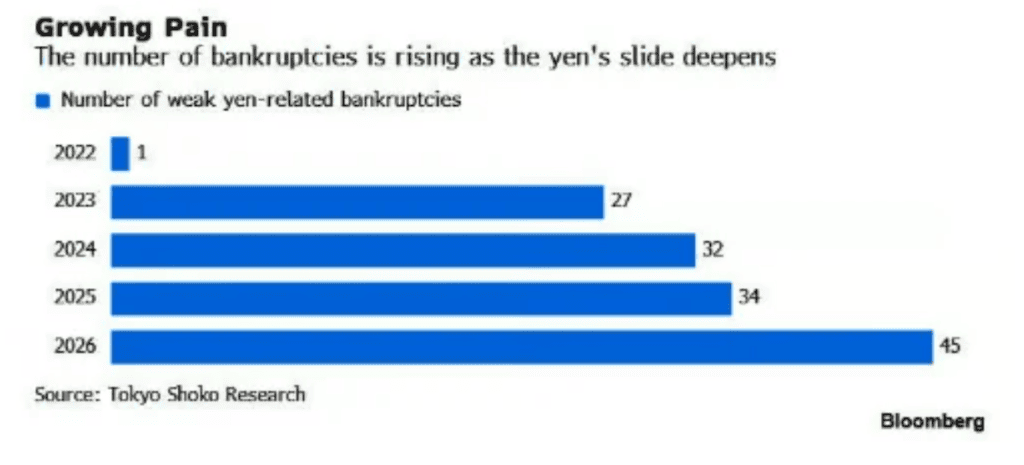
‼️Japan's weak yen is driving a record wave of bankruptcies:
45 Japanese firms went bankrupt in the first half of 2026, citing the weak yen, the highest H1 total since at least 2022.
This is up +32.4% from 34 in the first half of 2025, and up from 27 in 2023.
This comes as the… pic.twitter.com/5s87J48gqe
— Global Markets Investor (@GlobalMktObserv) July 6, 2026
Japanese bond yields are soaring.
Yen is now the weakest in 40 years.
Bankruptcies have reached a 4-year high.
BOJ is still hawkish and looking for more rate hikes.
Japan's economy looks cooked. pic.twitter.com/tgS01vV0f0
— Ted (@TedPillows) July 6, 2026
Japanese Yen will collapse to 165 against the U.S. Dollar, its weakest level since 1986, warns Goldman Sachs 🚨 🚨 pic.twitter.com/Z1yqLRwpeP
— Barchart (@Barchart) July 6, 2026
👀pic.twitter.com/ZlmHcA6Cr1 https://t.co/fvIbcQzNrJ
— Financelot (@FinanceLancelot) July 5, 2026
The next Bank of Japan Monetary Policy Meeting is July 30-31, 2026.
Policy decision and outlook report expected on July 31.
Markets will be watching closely for any signals on rates amid the yen’s recent weakness near 162.