The numbers finally crossed a line that people in Washington used to swear we would never cross, and now that we are here the reaction feels almost casual.
The $38 trillion national debt to blame for over $1 trillion in annual interest payments
America’s fiscal outlook continues to enter uncharted territory, with the Committee for a Responsible Federal Budget (CRFB) projecting the era of trillion-dollar annual interest payments has arrived. In a grim fiscal milestone first breached in fiscal year 2025, the costs to service the nation’s ballooning debt have spiraled, creating a financial pickle that threatens to squeeze the federal budget for decades to come.
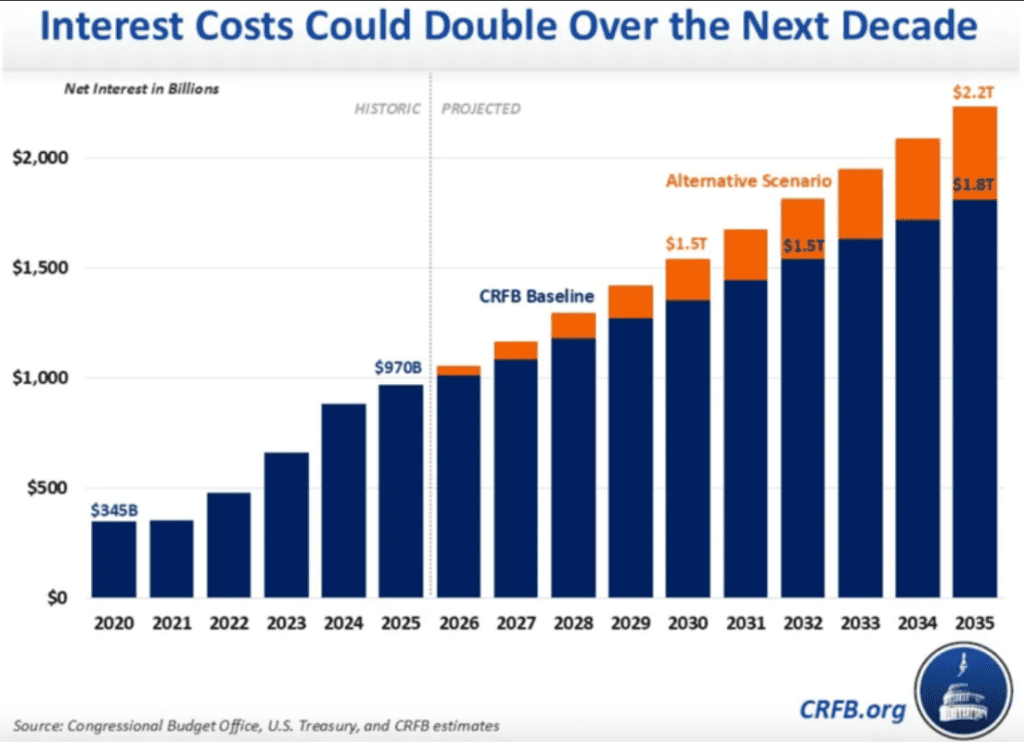
According to an analysis released by the nonpartisan budget watchdog on Dec. 16, the $38 trillion national debt is “largely to blame for these high interest payments,” having climbed to equal 100% of the nation’s gross domestic product (GDP). While the specific line item for net interest in the federal budget totaled $970 billion for the fiscal year, the Congressional Budget Office (CBO) indicates actual spending for net interest payments on the public debt broke the barrier of $1 trillion for the first time in FY 2025. Over the coming decade, the CRFB projects these figures will increase, surpassing $1.5 trillion in 2032 and $1.8 trillion in 2035.
If (as looks increasingly likely) the Supreme Court finds many of the Trump administration’s tariffs illegal, and provisions in the One Big Beautiful Bill Act are made permanent without offsets, the CRFB estimates interest payments passing $2.0 trillion in 2034 and $2.2 trillion in 2035. The watchdog noted with alarm just five years ago, in FY 2020, net interest costs were a relatively manageable $345 billion, but have roughly tripled since then amid a flurry of pandemic-related emergency spending. Furthermore, the CRFB outlook suggests this is not a temporary spike, but the “new norm.”
Researchers and budget analysts warn that a combination of higher interest rates, slower economic growth, and persistent deficits is pushing the U.S. fiscal position into dangerous territory. When the economy grows slower than the cost of borrowing, debt servicing accelerates out of balance.
The US budget math is looking dangerous
In the movie The Princess Bride, one of the characters frequently refers to events unfolding before them as “inconceivable” until one of his underlings points out, “You keep using that word. I do not think it means what you think it means.”
In a similar—albeit far less humorous—world, “unsustainable” is often used to refer to the level and the path of federal debt. For decades, so-called budget hawks have warned that the level of debt carried by the U.S. federal government was unsustainable.
But what do these budget hawks mean by unsustainable? Conversely, what do doves mean when they counter that the debt is sustainable? If the hawks mean that the government will not, in near-term debt auctions, be able to find investors in government bills and bonds willing to lend at the going rate of interest, then the Princess Bride quote seems applicable. The U.S. debt market is the largest, most liquid, lowest-risk sovereign debt market in history. For decades, the interest-rate record from that market has not reflected obvious sustainability concerns; to the contrary, the historical record over the last few decades directly contradicts these concerns, as rates on government debt have generally drifted down even as publicly held debt has drifted up.[1]