This is one of those stories that sounds like science fiction until you see the numbers.
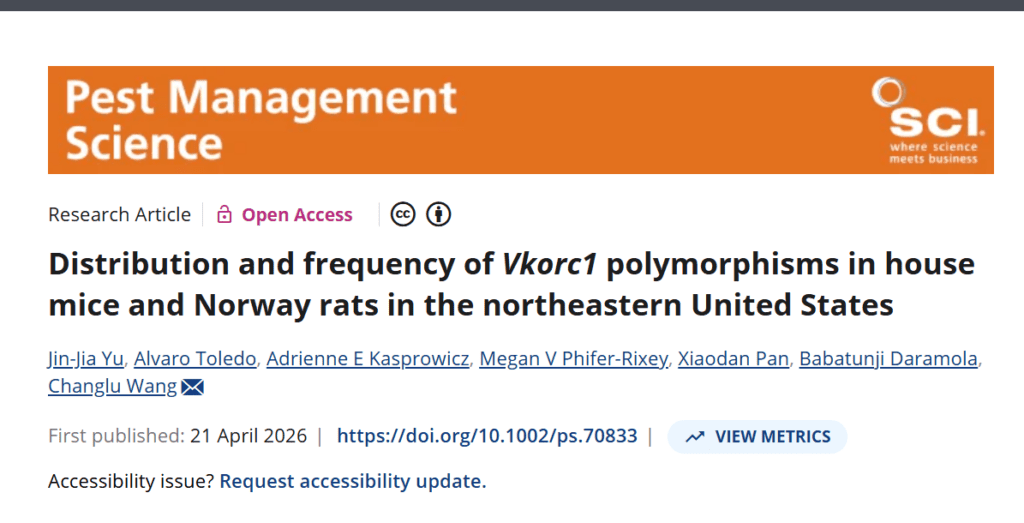
Researchers at Rutgers tested urban rodents across New York, New Jersey, Pennsylvania, and Washington, DC, and found that 84% of house mice carried at least one genetic mutation linked to resistance against common anticoagulant rodenticides.
Even Norway rats, which adapted more slowly, showed resistance mutations in 35% of the animals tested.
That’s not a handful of tough rodents.
That’s a large share of the population evolving around one of our most common pest control tools.
The study also found new Vkorc1 gene mutations that hadn’t been reported before, suggesting the evolutionary process is still happening, not slowing down.
What’s driving it?
Decades of relying on the same class of poisons.
The rodents most susceptible to the poison die first. The ones carrying resistance genes survive, reproduce, and pass those genes to the next generation. Repeat that process over enough years, and the poison becomes less effective.
The difference between mice and rats is interesting too.
House mice appear to be adapting much faster than Norway rats, something researchers believe may be tied to differences in behavior and breeding patterns.
The bigger question is what comes next.
If one of the main tools for controlling urban rodent populations keeps losing effectiveness, cities may have to rely much more on sanitation, building maintenance, trapping, and other integrated pest management strategies instead of simply putting out more poison.
This study isn’t saying rodenticides no longer work.
It is saying evolution isn’t waiting for us to come up with a new plan.