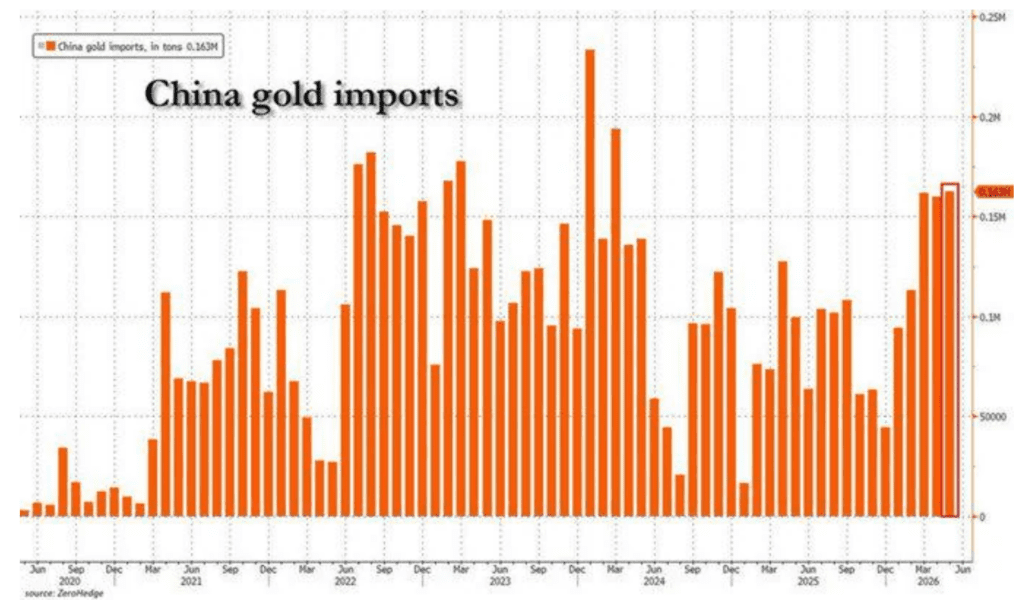
China imported 163 tonnes of gold in May, the largest monthly haul since March 2024.
Then I looked at the rest of the numbers.
This was the third straight month with gold imports above 150 tonnes.
During the first five months of 2026, China imported 692 tonnes, a 76% increase from the same period a year ago.
That’s not a one month anomaly.
It’s a sustained surge in physical gold demand.
The buying isn’t just coming from households snapping up bars and coins either.
The People’s Bank of China added another 10 tonnes in May, marking its 19th consecutive month of gold purchases. That pushed official gold reserves to a record 2,331 tonnes.
Now put those numbers next to another one.
China’s M2 money supply has climbed to roughly 240% of GDP, one of the highest levels among major economies. In dollar terms, M2 has expanded by more than 500% since the 2008 financial crisis.
China’s is seeing unprecedented money supply growth:
China's M2 money supply is up to a record ~240% of GDP, the highest among any major economy in the world.
This metric has surged +100 percentage points since the 2008 Financial Crisis.
Over this period, China’s M2 money… pic.twitter.com/L27es1a9rK
— The Kobeissi Letter (@KobeissiLetter) June 29, 2026
That combination is fascinating.
On one hand, China continues expanding the money supply.
On the other, it’s steadily accumulating one of the few assets that governments can’t create with a printing press.
Meanwhile, the U.S. dollar outperformed every other G10 currency this month.
https:/twitter.com/steve_hanke/status/2071187352471658550
So you end up with an interesting picture.
China is buying gold at one of its fastest rates in years.
Its central bank keeps adding to record reserves.
Its money supply keeps growing.
At the same time, the dollar remains the strongest major currency over the past month.
It’s why China keeps accumulating physical gold year after year while its balance sheet keeps getting larger.