Nobody in DC gives a fuck about your wallet. Consumers face brutal inflation and crumbling dollar value.
And a 97% loss since 1913 (founding of the Fed) and an 88% loss since 1971 (closing of the gold window and 100% fiat currency) in the purchasing power of the dollar — by government measurements, which are surely understated in loss. pic.twitter.com/kukqbEd2Fy
— David Sommers (@dgsommersmkts) June 10, 2026
BREAKING: President Trump says "I love the inflation" and explains why after US CPI inflation rises to 4.2%.
Trump also announces that the US has been taking oil from Iran, including 22 ships of oil "last night." pic.twitter.com/qPX9HNrsSm
— The Kobeissi Letter (@KobeissiLetter) June 10, 2026
Mockler: Trump is definitely in over his head. This 4 to 6 week timeline is now over 100 days. And we've had all of the costs of this with none of the benefits. Americans are struggling with high gas prices with the economy. And yet we are being lied to on TV by people who are… pic.twitter.com/zFJzT2NFRy
— Acyn (@Acyn) June 10, 2026
ENERGY SHOCK DRIVES U.S. INFLATION
Energy costs accounted for over 60% of U.S. inflation in May, according to the Labor Department. Gasoline prices jumped 41% year over year, while diesel surged 59%. Electricity costs also rose 5.9%, outpacing overall inflation. Rising fuel and…
— *Walter Bloomberg (@DeItaone) June 10, 2026
Margin Debt as a % of M2 is now at its 2nd highest level in history, just behind the Dot Com Bubble 🚨🚨 pic.twitter.com/xAEMkaeHuk
— Barchart (@Barchart) June 10, 2026
The basic American life now costs about 40% more income than it did in 2001
byu/Ok_Astronomer_7797 inworldinsights
“It has become noticeably harder for young Americans to make it into the middle class. In his article “Is the Middle Class Still Attainable?”, Tom Owens uses a simple way to measure it: take the median home price, add the cost of an affordable car, and compare that total with annual income.
In 2001, the median home in the United States cost about $140,000. Median household income was about $42,000 a year. So a home cost roughly 3.3 years of income. Add a Toyota Corolla for $13,000, and the basic starting package – a home plus an inexpensive car – came to about 3.6 years of income.
In 2024, the median home is about $404,500. A Corolla is around $22,000. Household income is roughly $83,000. The same package now costs about 5.1 years of income.
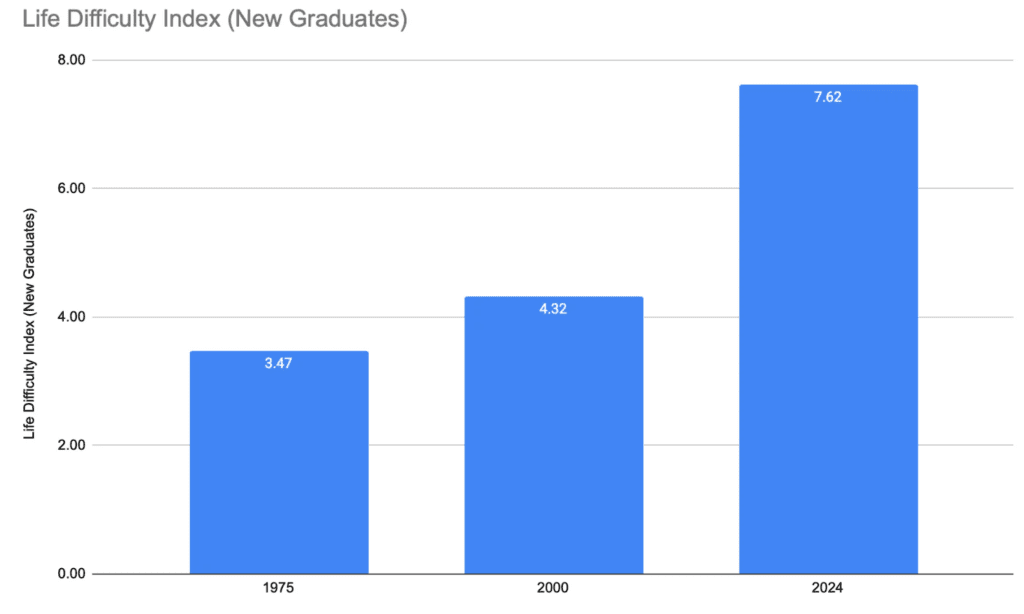
The gap is even more obvious for college graduates. In 2000, the average starting salary for a graduate was about $35,400. Today, it is around $56,000. Salaries have gone up, but housing has moved much further out of reach. By Owens’s calculation, his Life Difficulty Index for college graduates rose from 4.32 in 2000 to 7.61 in 2024. For late baby boomers in 1975, the same figure was about 3.47.
The point is clear from the numbers: young Americans are not starting out under the same conditions their parents did. A house, a car, and an independent life now take a much larger share of income than they used to.”